
Rewilding the Word #17
NOTE: For the best copy of this Meditation, with all formatting in place, click here for the PDF:
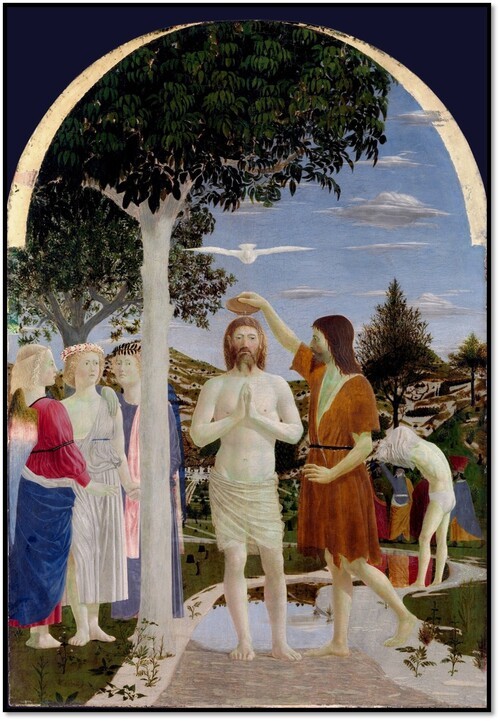
I have begun to write this on the feast of the Baptism of Jesus, which this year, on the Catholic liturgical calendar, landed on Sunday, January 11th.
Notice the powerful sense of peace that emanates from this painting. We grow in a conviction that the Holy Spirit has not given this divine gift – “a peace that the world cannot give” – only to those in this painted scene but also to us who are looking in. Such divine peace cannot be contained by a painting. Christ is looking at us, pleased to see us startled to be receiving the same gift that He was receiving at the River Jordan.
Notice also the orderliness of this painting, which is perhaps a compositional reason why we find such peace when beholding it. We recall St. Augustine’s remark that “Peace is the tranquility of order.”3 Such order is the painter’s way of understanding and expressing how our disordered affections are what John the Baptist came to challenge, and if he could, to re-order, “making straight” our crookedness of character. We recall here C.S. Lewis’ important word in his Space or Cosmic Trilogy books (published 1938-1945), in which he recognizes how sin leaves a person “bent” – notice over there to the right that bent man, getting himself ready for Baptism. Jesus entered a world of orderliness that John and his ministry had prepared, “a people set apart”, whom John had made capable of receiving their Savior.
We notice how both Jesus and John stand beautifully balanced, with John poised as if he were the principal dancer in the greatest Ballet.
A Quote - Leiva, Erasmo. Fire Of Mercy, Vol. 1 (Kindle Locations 1774-1778), Ignatius Press (April 1996) – “Repentance is grounded, not in a desire to abase myself, but in a clear understanding and a profound conviction of my great worth in the eyes of God.
Notice the powerful sense of peace that emanates from this painting. We grow in a conviction that the Holy Spirit has not given this divine gift – “a peace that the world cannot give” – only to those in this painted scene but also to us who are looking in. Such divine peace cannot be contained by a painting. Christ is looking at us, pleased to see us startled to be receiving the same gift that He was receiving at the River Jordan.
Notice also the orderliness of this painting, which is perhaps a compositional reason why we find such peace when beholding it. We recall St. Augustine’s remark that “Peace is the tranquility of order.”3 Such order is the painter’s way of understanding and expressing how our disordered affections are what John the Baptist came to challenge, and if he could, to re-order, “making straight” our crookedness of character. We recall here C.S. Lewis’ important word in his Space or Cosmic Trilogy books (published 1938-1945), in which he recognizes how sin leaves a person “bent” – notice over there to the right that bent man, getting himself ready for Baptism. Jesus entered a world of orderliness that John and his ministry had prepared, “a people set apart”, whom John had made capable of receiving their Savior.
We notice how both Jesus and John stand beautifully balanced, with John poised as if he were the principal dancer in the greatest Ballet.
A Quote - Leiva, Erasmo. Fire Of Mercy, Vol. 1 (Kindle Locations 1774-1778), Ignatius Press (April 1996) – “Repentance is grounded, not in a desire to abase myself, but in a clear understanding and a profound conviction of my great worth in the eyes of God.
A Story
The Archbasilica of St. John Lateran in Rome is the Cathedral church of the Bishop of Rome (who is also Pope of the universal Church), and it is dedicated to the memory of St. John the Baptist – “least of the new and greatest of the old”.
I love it that the first church, as an acknowledged public building in early 4th century Rome,4 was dedicated to the last prophet of the Old Testament, associated with the one who recognized when the Christ had come into their midst, and then who pointed at Him, helping others see Him, who had not noticed that He was right there, in their midst – “There, He is the Lamb of God, He whom we have sought through endless ages. Pay attention to Him!”
The Church’s highest capacity is not to be the location where God dwells but to be a community of people with a highly developed capacity to recognize quicker than anyone else when God has come into our midst and who help others to see God and to trust Him.
The Archbasilica of St. John Lateran in Rome is the Cathedral church of the Bishop of Rome (who is also Pope of the universal Church), and it is dedicated to the memory of St. John the Baptist – “least of the new and greatest of the old”.
I love it that the first church, as an acknowledged public building in early 4th century Rome,4 was dedicated to the last prophet of the Old Testament, associated with the one who recognized when the Christ had come into their midst, and then who pointed at Him, helping others see Him, who had not noticed that He was right there, in their midst – “There, He is the Lamb of God, He whom we have sought through endless ages. Pay attention to Him!”
Charles Wesley (written in 1744) –
Come, thou long expected Jesus,
born to set thy people free;
from our fears and sins release us,
let us find our rest in thee.
Israel's strength and consolation,
hope of all the earth thou art;
dear desire of every nation,
joy of every longing heart.
The Church’s highest capacity is not to be the location where God dwells but to be a community of people with a highly developed capacity to recognize quicker than anyone else when God has come into our midst and who help others to see God and to trust Him.
A Text
Malcolm Guite (born 1957)5 – “A Sonnet: St. John the Baptist: St. John’s Eve”6 -
Malcolm Guite (born 1957)5 – “A Sonnet: St. John the Baptist: St. John’s Eve”6 -
Midsummer night, and bonfires on the hill
Burn for the man who makes way for the Light:
‘He must increase and I diminish still,
Until his sun illuminates my night.’
So John the Baptist pioneers our path,
Unfolds the essence of the life of prayer,
Unlatches the last doorway into faith,
And makes one inner space an everywhere.
Least of the new and greatest of the old,
Orpheus7 on the threshold with his lyre,
He sets himself aside, and cries “Behold
The One who stands amongst you comes with fire!”
So, keep his fires burning through this night,
Beacons and gateways for the child of light.
A Close Reading of the Text
Midsummer night, and bonfires on the hill – Britannica notes that “Midsummer is celebrated in many countries but is synonymous with Scandinavia, where it is observed as a national holiday in Sweden and Finland. … In Scandinavia and elsewhere, many Midsummer celebrations are held over several days and often occur in tandem with St. John’s Eve (June 23rd) festivities, which usher in the feast day of St. John the Baptist (June 24th).” The rituals associated with this annual celebration magnified the natural good that people felt at the time of the year, when the weather was most conducive to living outside. People wanted to live out in the open and not just physically outside. Think here of Genesis 3:
It will always be the active effect in us of “the enemy of our human nature” (Satan) to convince us that we need to hide, to be afraid to live, if you will, “out in the open” - in honesty, openness, with a candor unsettling or even frightening to people who prefer to hide.9 Those “bonfires on the hill” were lit, a ritual of Midsummer, as lights kindled to drive away evil spirits, to free us from fear, from the need to hide. John the Baptist was both fire and light, but of less incandescent splendor than the One for whom John gave his life:
Until his sun illuminates my night – At first, this is an apparently ponderous expression, over-wrought. We know that the Sun never illuminates the night. But then we catch on. The poet elaborates through a different metaphor of how the One grows greater (the Sun) and he, John, grows less. The poet articulates how John is the Moon (and its phases), which has no light of its own, which shines with a borrowed light – the Sun – but which “announces” in the night that the Light exists and will indeed come again – “In a dark time / the eye begins to see” as the poet Theodore Roethke put it.
Midsummer night, and bonfires on the hill – Britannica notes that “Midsummer is celebrated in many countries but is synonymous with Scandinavia, where it is observed as a national holiday in Sweden and Finland. … In Scandinavia and elsewhere, many Midsummer celebrations are held over several days and often occur in tandem with St. John’s Eve (June 23rd) festivities, which usher in the feast day of St. John the Baptist (June 24th).” The rituals associated with this annual celebration magnified the natural good that people felt at the time of the year, when the weather was most conducive to living outside. People wanted to live out in the open and not just physically outside. Think here of Genesis 3:
8 The man and his wife heard the sound of Yahweh God walking in the garden in the cool of the day, and they hid from Yahweh God among the trees of the garden. 9 But Yahweh God called to the man. ‘Where are you?’ he asked. 10 ‘I heard the sound of you in the garden,’ he replied. ‘I was afraid because I was naked, so I hid.’8
It will always be the active effect in us of “the enemy of our human nature” (Satan) to convince us that we need to hide, to be afraid to live, if you will, “out in the open” - in honesty, openness, with a candor unsettling or even frightening to people who prefer to hide.9 Those “bonfires on the hill” were lit, a ritual of Midsummer, as lights kindled to drive away evil spirits, to free us from fear, from the need to hide. John the Baptist was both fire and light, but of less incandescent splendor than the One for whom John gave his life:
The One who stands amongst you comes with fire!”
So, keep his fires burning through this night,
Beacons and gateways for the child of light.
Until his sun illuminates my night – At first, this is an apparently ponderous expression, over-wrought. We know that the Sun never illuminates the night. But then we catch on. The poet elaborates through a different metaphor of how the One grows greater (the Sun) and he, John, grows less. The poet articulates how John is the Moon (and its phases), which has no light of its own, which shines with a borrowed light – the Sun – but which “announces” in the night that the Light exists and will indeed come again – “In a dark time / the eye begins to see” as the poet Theodore Roethke put it.
John 1:
8 He was not the light,
he was to bear witness to the light.
9 The Word was the real light
that gives light to everyone;
he was coming into the world.*10
Unlatches the last doorway into faith – I do not know what this means. So, let’s see what we can figure out. “Unlock” suggests a reality into which we seek to enter but which door someone (Who?) has locked (Why?) And we know that we lack the key. We think of that traditional language that Christ and through His life and sacrifice “opened for us the gates of Heaven”. But “Heaven” seems something different than “the last doorway into faith”. And it feels awkward to imagine faith as a location, as if a room into which to go and to remain. But perhaps the most important part of this poetic line is a sound. We have heard that sound before. Recall a time when you felt trapped, blocked, or stuck … and you did not know what to do or how to get yourself out. It feels like a location. The sound of that locked door (either a physical or a psychological or a spiritual or theological door) being “unlatched” is a sound we love. “Someone has found me! He or she has come! He or she will know how to guide me out of here.” Can you hear that sound?
There have been a few truly great Teachers in my life whose words were filled with keys to locked doors that I never knew that I had.
A Prayer
Fr. Teilhard de Chardin, SJ11 -
Fr. Teilhard de Chardin, SJ11 -
Above all, trust in the slow work of God.
We are quite naturally impatient in everything to reach the end without delay.
We should like to skip the intermediate stages.
We are impatient of being on the way to something unknown, something new.
And yet it is the law of all progress
that it is made by passing through some stages of instability—
and that it may take a very long time.
And so I think it is with you;
your ideas mature gradually—let them grow,
let them shape themselves, without undue haste.
Don’t try to force them on,
as though you could be today what time
(that is to say, grace and circumstances acting on your own good will)
will make of you tomorrow.
Only God could say what this new spirit
gradually forming within you will be.
Give Our Lord the benefit of believing
that his hand is leading you,
and accept the anxiety of feeling yourself
in suspense and incomplete.
Notes
1 Grove Art Online (Oxford) at Piero [Pietro de Benedetto di Pietro] della Francesca (c. 1415-1492), Italian painter and theorist. His work is the embodiment of rational, calm, monumental painting in the Italian early Renaissance, an age in which art and science were indissolubly linked through the writings of Leon Battista Alberti. Born two generations before Leonardo da Vinci, Piero was similarly interested in the scientific application of the recently discovered rules of perspective to narrative or devotional painting, especially in fresco, of which he was an imaginative master; and although he was less universally creative than Leonardo and worked in an earlier idiom, he was equally keen to experiment with painting technique. Piero was as adept at resolving problems in Euclid, whose modern rediscovery is largely due to him, as he was at creating serene, memorable figures, whose gestures are as telling and spare as those in the frescoes of Giotto or Masaccio. … In his best works, such as the frescoes in the Bacci Chapel in S Francesco, Arezzo, there is an ideal balance between his serene, classical compositions and the figures that inhabit them, the whole depicted in a distinctive and economical language.
2 See: https://religiana.com/sansepolcro-cathedral.
2 See: https://religiana.com/sansepolcro-cathedral.
3 “In its most general meaning peace (pax) is the absence of dissension and strife. As such it is realized most perfectly in a world of absolute unity, a world in which there is “One” and not “Many.” In the really existing world of multiplicity peace is found in the tranquility of order (tranquilitas ordinis), the arrangement of like and unlike things whereby each of them has its proper place (civ. Dei 19.13.1). Peace among human beings results from a “oneness of heart” (concordia) rooted in the love of friendship. Peace for a human being is perfect only when the person’s love is well ordered and possesses everything that it desires (en. Ps. 84.10; s. 357.2; mor. 1.3.4). [Burt, Donald X. “Peace.” Augustine through the Ages: An Encyclopedia, edited by Allan D. Fitzgerald, William B. Eerdmans Publishing Company, 1999, p. 629.]
4 For nearly three hundred years the Church had been a church-in-hiding, one that could not be public because of the Roman state’s commitment to exterminate the Church. When the Church was officially “allowed” to exist publicly - Constantine I or Constantine the Great (kŏnʹstəntēn, –tīn), 288? – 337 CE, Roman emperor, b. Naissus (present-day Niš, Yugoslavia; the Edict of Milan of 313 CE - and then some forty years later, when Christianity became the preferred Religion of the Roman elite, there were many who felt that something essential, something centrally important about the Church was being eroded, even corrupted. Sociologists of Christianity have associated the rise of the monastic religious Orders, and the hermit traditions in the deserts, as being a deliberate reaction to the popularity and public esteem of Christianity – expressing in rigorous life the desire to maintain in the Church that clarity and conviction that those three hundred years of persecution had given the Church.
4 For nearly three hundred years the Church had been a church-in-hiding, one that could not be public because of the Roman state’s commitment to exterminate the Church. When the Church was officially “allowed” to exist publicly - Constantine I or Constantine the Great (kŏnʹstəntēn, –tīn), 288? – 337 CE, Roman emperor, b. Naissus (present-day Niš, Yugoslavia; the Edict of Milan of 313 CE - and then some forty years later, when Christianity became the preferred Religion of the Roman elite, there were many who felt that something essential, something centrally important about the Church was being eroded, even corrupted. Sociologists of Christianity have associated the rise of the monastic religious Orders, and the hermit traditions in the deserts, as being a deliberate reaction to the popularity and public esteem of Christianity – expressing in rigorous life the desire to maintain in the Church that clarity and conviction that those three hundred years of persecution had given the Church.
5 Wikipedia: “Ayodeji Malcolm Guite (b. 1957) is an English poet, singer-songwriter, Anglican priest and academic. Born in Nigeria to British expatriate parents, Guite earned degrees from the University of Cambridge and Durham University.”
6 See: https://malcolmguite.wordpress.com/2018/06/22/a-pair-of-sonnets-for-st-john-the-baptist-2/. This sonnet can be found in Guite’s collection, Sounding the Seasons: Poetry for the Christian Year (published November 2012).
7 Mark Carwright in World History Encyclopedia at “Orpheus” - Orpheus is a figure from ancient Greek mythology, most famous for his virtuoso ability in playing the lyre or kithara. His music could charm the wild animals of the forest, and even streams would pause and trees bend a little closer to hear his sublime singing. He was also a renowned poet, travelled with Jason and the Argonauts in search of the Golden Fleece, and even descended into the Underworld of Hades to recover his lost wife Eurydice.
6 See: https://malcolmguite.wordpress.com/2018/06/22/a-pair-of-sonnets-for-st-john-the-baptist-2/. This sonnet can be found in Guite’s collection, Sounding the Seasons: Poetry for the Christian Year (published November 2012).
7 Mark Carwright in World History Encyclopedia at “Orpheus” - Orpheus is a figure from ancient Greek mythology, most famous for his virtuoso ability in playing the lyre or kithara. His music could charm the wild animals of the forest, and even streams would pause and trees bend a little closer to hear his sublime singing. He was also a renowned poet, travelled with Jason and the Argonauts in search of the Golden Fleece, and even descended into the Underworld of Hades to recover his lost wife Eurydice.
8 The New Jerusalem Bible. Doubleday, 1990, p. Ge 3:8–10.
9 Note: that first hiding of human beings is clearly associated with their moral failure, in that pre-historical Time before Morality (as a code) existed, when it was solely about one’s closest relationships and the trust in them. To use the biblical language, they hid because they had sinned. But very often people hide not because they have sinned, but because they have been hunted by malign human actors (political, social, ecclesial, familial), who fully intend to harm them. How often have those malign human actors then cloaked their maliciousness by blaming those whom they victimize or desire to victimize.
* 3:19; 8:12b; 12:46; Ws 7:26
10 The New Jerusalem Bible. Doubleday, 1990, p. Jn 1:8–9.
9 Note: that first hiding of human beings is clearly associated with their moral failure, in that pre-historical Time before Morality (as a code) existed, when it was solely about one’s closest relationships and the trust in them. To use the biblical language, they hid because they had sinned. But very often people hide not because they have sinned, but because they have been hunted by malign human actors (political, social, ecclesial, familial), who fully intend to harm them. How often have those malign human actors then cloaked their maliciousness by blaming those whom they victimize or desire to victimize.
* 3:19; 8:12b; 12:46; Ws 7:26
10 The New Jerusalem Bible. Doubleday, 1990, p. Jn 1:8–9.
11 Teilhard de Chardin, Pierre (1881–1955) French theologian and scientist. Born near Clermont in central France, he entered the Society of Jesus novitiate at Aix-en-Provence in 1899 and was ordained priest in 1911. During his long training he studied theology but was also strongly attracted to the natural sciences, especially geology and paleontology. After service in the First World War, he was able to devote himself to his scientific studies. For many years he worked in China and gained a notable reputation as a paleontologist. His last years were spent in the USA. At the time of his death he had published only scientific papers, for he had not been able to obtain permission for the publication of his religious and theological works. These appeared from 1955 onward and at once made a powerful impression as a new synthesis of science and religion. [Endean, SJ, Philip. “Teilhard de Chardin, Pierre.” The Oxford Dictionary of the Christian Church, edited by Andrew Louth, Fourth Edition, vol. 2, Oxford University Press, 2022, p. 1893.]
Posted in Rewilding the Word
Recent
Categories
Tags
Archive
2026
January
February
March
October
2025
January
March
June
October
2024
January
March
September
October
2023
March
November
2022
2021
No Comments