
Lenten Meditation, Sixth Sunday of Lent 2026
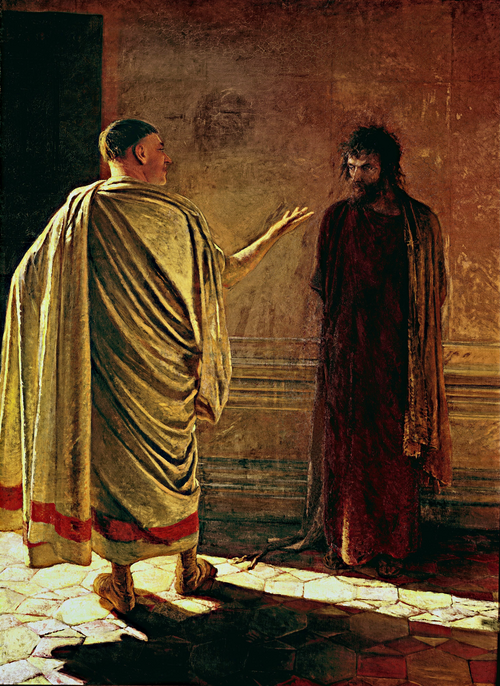
What is Truth? Christ and Pilate (1890) by Nikolai Ge (1831-1894)1, held in the State Tretyakov Gallery in Moscow, Russia. M.N. Sokolov writes: “Notable among the works marking the opening of this new period is What is Truth? (1890; Moscow, Tretyakov Gallery), in which Christ is shown before Pilate who puts his ironic question to him, represents, in the words of Tolstoy, ‘an epoch in Christian painting’.”
For the best copy of this Meditation, with all formatting in place, click here for the PDF:
Matthew 27 (NJB): 19 Now as he was seated in the chair of judgement, his wife sent him a message, ‘Have nothing to do with that upright man; I have been extremely upset today by a dream that I had about him.’2
Note
We have taken our cue from the Gospels given to be heard and contemplated in Catholic churches on each of the Sundays of Lent. We have progressed from Temptation (Matthew 4) to Transfiguration (Matthew 17) to Conversation (John 4), to Conflict (John 9), to Death (John 11), and finally to Love Unconditioned (St. Matthew’s Passion account).
Seeing the Painting
Notice how the painter has Pontius Pilate standing in the bright light, while Jesus, the Light of the World, is looking at Pilate from the shadows.
Isaiah 9 (NJB): 1(3) The people that walked in darkness have seen a great light; on the inhabitants of a country in shadow dark as death light has blazed forth.3
The stillness of Jesus – which is His “answer” to Pilate’s questions - is affecting Pilate. Pilate stands bathed in the light, as if he is being given a chance to follow the truth to the Truth who stands right there – “Who do you say that I am?”.
We want to say, “Pilate, you feel His effect in you, don’t you? You know already that something much greater than an interrogation is happening here. This Galilean stranger has brought you into the light. Don’t turn away; go into it. This man Jesus is not making this about him; it is only about you and the light in which He has placed you.”
Let us experience the profound stillness of Jesus, who is giving Pilate room to see the Choice being given him. Even here, the courtesy of Christ shines brightly. No victim here, but the Master at work.
Notice how this painting captures a moment early in the conversation. Everything about Pilate suggests that he feels himself completely in charge. The easy smile on his untroubled face; his right arm gesturing toward Jesus – notice that arm is bathed in light – but also that it is pressing into Jesus’ private space. Doesn’t that gesture remind you of the foolishness of kids who at the Zoo reach through the bars toward the lion who watches them with stillness and barely contained fierceness? “Be careful, Pilate. You have no idea with whom you are dealing. It is the Lord of the world.”
Notice how confident Pilate is (but so is Jesus). But as is the case with all who get self-satisfied, too sure of their stature and importance, Pilate has failed to notice how dark is the shadow that follows him, that is attached to him, which the Light exposes.7 (Jesus casts no shadow.)
We want to say, “Pilate, you feel His effect in you, don’t you? You know already that something much greater than an interrogation is happening here. This Galilean stranger has brought you into the light. Don’t turn away; go into it. This man Jesus is not making this about him; it is only about you and the light in which He has placed you.”
Let us experience the profound stillness of Jesus, who is giving Pilate room to see the Choice being given him. Even here, the courtesy of Christ shines brightly. No victim here, but the Master at work.
Erasmo Leiva-Merikakis, OCSO4 - However, the manner of Jesus’ presence, his cryptic reply and his emphatic silences soon begin to have an interior effect on the man Pilate. Slowly it begins to dawn on the administrative governor that the silent, bound man before him might himself be a hêgemón [Greek for “commander in chief”, or “one who leads the way”] but in an altogether different sense: one who mysteriously leads the way, not politically, but spiritually, and not only in Judea and among the Jews, but everywhere and for everyone.5
Notice how this painting captures a moment early in the conversation. Everything about Pilate suggests that he feels himself completely in charge. The easy smile on his untroubled face; his right arm gesturing toward Jesus – notice that arm is bathed in light – but also that it is pressing into Jesus’ private space. Doesn’t that gesture remind you of the foolishness of kids who at the Zoo reach through the bars toward the lion who watches them with stillness and barely contained fierceness? “Be careful, Pilate. You have no idea with whom you are dealing. It is the Lord of the world.”
John 9 (NJB): 36 ‘Sir,’ the man replied, ‘tell me who he is so that I may believe in him.’ 37 Jesus said, ‘You have seen him; he is speaking to you.’6
Notice how confident Pilate is (but so is Jesus). But as is the case with all who get self-satisfied, too sure of their stature and importance, Pilate has failed to notice how dark is the shadow that follows him, that is attached to him, which the Light exposes.7 (Jesus casts no shadow.)
Notice, finally, where Jesus is looking. Often people assume (and often because their religious leaders want them to assume this) that God is most interested in their sins – the shadow that we cast in the world.8 Jesus is paying no attention to that inky shadow behind Pilate; Jesus keeps his eyes on Pilate upon whom the light is shining.
Quotes
Ursula Le Guin, The Farthest Shore, Chapter 13, “The Stone of Pain”, pp. 243-244 – And that was all there was left to do. Beyond that he could not see, the mist was all about him. He felt about in his pockets as he sat there, huddled with Ged10 in the fog, to see if he had anything useful. In his tunic pocket was a hard, sharp-edged thing. He drew it forth and looked at it, puzzled. It was a small stone, black, porous, hard. He almost tossed it away. Then he felt the edges of it in his hand, rough and searing, and felt the weight of it, and knew it for what it was: a bit of rock from the Mountains of Pain. It had caught in his pocket as he climbed or when he crawled to the edge of the pass with Ged. He held it in his hand, the unchanging thing, the stone of Pain. He closed his hand on it and held it. And he smiled then, a smile both somber and joyous, knowing, for the first time in his life, alone, unpraised, and at the end of the world, victory.
Matthew 12 (NJB):
18 Look! My servant whom I have chosen, my beloved,
in whom my soul delights,
I will send my Spirit upon him,
and he will present judgement to the nations;
19 he will not brawl or cry out,
his voice is not heard in the streets,
20 he will not break the crushed reed,
or snuff the faltering wick,
21 until he has made judgement victorious;
in him the nations will put their hope.9
Quotes
Ursula Le Guin, The Farthest Shore, Chapter 13, “The Stone of Pain”, pp. 243-244 – And that was all there was left to do. Beyond that he could not see, the mist was all about him. He felt about in his pockets as he sat there, huddled with Ged10 in the fog, to see if he had anything useful. In his tunic pocket was a hard, sharp-edged thing. He drew it forth and looked at it, puzzled. It was a small stone, black, porous, hard. He almost tossed it away. Then he felt the edges of it in his hand, rough and searing, and felt the weight of it, and knew it for what it was: a bit of rock from the Mountains of Pain. It had caught in his pocket as he climbed or when he crawled to the edge of the pass with Ged. He held it in his hand, the unchanging thing, the stone of Pain. He closed his hand on it and held it. And he smiled then, a smile both somber and joyous, knowing, for the first time in his life, alone, unpraised, and at the end of the world, victory.
W.H. Auden (1907-1973)11, “As I Walked Out One Evening” –
William Barry, SJ, “Discernment of Spirits as an Act of Faith” in An Ignatian Spirituality Reader – “The discernment of the spirits rests on the belief that the human heart is a battleground where God and the evil one struggle for mastery. Jesus of Nazareth himself believed this. In the desert he had been tempted by the evil one masquerading as an angel of light. If these were real temptations, then he, like us, had to discern the movements inspired by God from those inspired by the evil one. He, too, had to make an act of faith in who God really is, based on his experiences and his knowledge of the Scriptures of his people. Jesus came to recognize who the real enemy of God’s rule is. He cast out demons and equated his power over the demons as a sign of God’s coming to rule: ‘But if it is by the finger of God that I cast out demons, then the kingdom of God has come upon you.’ The majority party of the Pharisees and most Jews of the time saw the real enemy of Israel, and therefore of God, as the pagans, and especially the Roman occupiers. Repeatedly Jesus warned his hearers that the real enemy was Satan.” (My emphases.)
‘O stand, stand at the window
As the tears scald and start;
You shall love your crooked neighbour
With your crooked heart.’12
William Barry, SJ, “Discernment of Spirits as an Act of Faith” in An Ignatian Spirituality Reader – “The discernment of the spirits rests on the belief that the human heart is a battleground where God and the evil one struggle for mastery. Jesus of Nazareth himself believed this. In the desert he had been tempted by the evil one masquerading as an angel of light. If these were real temptations, then he, like us, had to discern the movements inspired by God from those inspired by the evil one. He, too, had to make an act of faith in who God really is, based on his experiences and his knowledge of the Scriptures of his people. Jesus came to recognize who the real enemy of God’s rule is. He cast out demons and equated his power over the demons as a sign of God’s coming to rule: ‘But if it is by the finger of God that I cast out demons, then the kingdom of God has come upon you.’ The majority party of the Pharisees and most Jews of the time saw the real enemy of Israel, and therefore of God, as the pagans, and especially the Roman occupiers. Repeatedly Jesus warned his hearers that the real enemy was Satan.” (My emphases.)
Thoughts
I consider this encounter between Jesus and Pilate as possibly the most significant of the Passion account. Why? Because it is here that the Son of God comes before “the world” in its self-confidence and self-satisfaction, in its organizational prowess, in its self-congratulating clarity about who is “in” and who is “out” of order. There. See them? Pilate looking at Jesus; Jesus looking at Pilate.
I esteem highly how our painter, Nikolai Ge, has left out the crowd and the Praetorian Guards and everyone else. There is only these two men: two individuals who are also symbols of two worlds at work inside our world.13
Our painter cuts to the heart of it all. He paints a scene of dark shadows and strong light; a place of heavy stone suggestive of a tomb; a “tomb” of the world into which Jesus has come through the door from a world of brilliant light into the shadowed lands. He finds Pilate trapped inside … as will always be the case with the powerful of this world. There is a strong suggestion that this “tomb” of entrapment has become, because Christ has come there, a “gate of Heaven”.
I consider this encounter between Jesus and Pilate as possibly the most significant of the Passion account. Why? Because it is here that the Son of God comes before “the world” in its self-confidence and self-satisfaction, in its organizational prowess, in its self-congratulating clarity about who is “in” and who is “out” of order. There. See them? Pilate looking at Jesus; Jesus looking at Pilate.
I esteem highly how our painter, Nikolai Ge, has left out the crowd and the Praetorian Guards and everyone else. There is only these two men: two individuals who are also symbols of two worlds at work inside our world.13
Our painter cuts to the heart of it all. He paints a scene of dark shadows and strong light; a place of heavy stone suggestive of a tomb; a “tomb” of the world into which Jesus has come through the door from a world of brilliant light into the shadowed lands. He finds Pilate trapped inside … as will always be the case with the powerful of this world. There is a strong suggestion that this “tomb” of entrapment has become, because Christ has come there, a “gate of Heaven”.
Genesis 28 (NJB): 15 Be sure, I am with you; I shall keep you safe wherever you go, and bring you back to this country, for I shall never desert you until I have done what I have promised you.’ 16 Then Jacob awoke from his sleep and said, ‘Truly, Yahweh is in this place and I did not know!’ 17 He was afraid and said, ‘How awe-inspiring this place is! This is nothing less than the abode of God, and this is the gate of heaven!’14 (My emphasis.)
See how our Lord strives to save Pilate, not Himself. Can you hear him? We must watch His lips - the voice a whisper, He says: “Unbind him, let him go free.”15
How ironic that Pilate was convinced that it was Jesus who was the prisoner in that place!
Prayer for the Sixth Week of Lent17
John 17 (NJB):
26 I have made your name known to them
and will continue to make it known,
so that the love with which you loved me may be in them,
and so that I may be in them.16
How ironic that Pilate was convinced that it was Jesus who was the prisoner in that place!
Prayer for the Sixth Week of Lent17
Almighty ever-living God,
who as an example of humility for the human race to follow
caused our Savior to take flesh and submit to the Cross,
graciously grant that we may heed his lesson of patient suffering
and so merit a share in his Resurrection.
Who lives and reigns with you in the unity of the Holy Spirit,
God, for ever and ever.18
Notes
1 M.N. Sokolov in Grove Art (Oxford) – “Ge [Gay], Nikolay (Nikolayevich) (b Voronezh, Feb 27, 1831; d Ivanovsky farm [now T. G. Shevchenko farm], Chernihiv region, Ukraine, June 13, 1894). … Russian painter. The son of a landowner and grandson of a French nobleman who emigrated during the French Revolution, he initially studied in the departments of mathematics of Kiev and St Petersburg universities (1847–50). In 1850 he enrolled at the Academy of Arts, St Petersburg, from which he graduated in 1857. … Ge gradually came to occupy a unique position in post-Romantic Russian art, anticipating the artistic quests of the 20th century in the passionate expressiveness of his work. In terms of iconography and ideas the determining influence on Ge from the 1880s onwards was the religious teaching of Lev Tolstoy, who became a close friend. Ge’s works moved towards a broad painterly style, pushing contrasts of colour and of light and shade to the limit. … Alongside his religious paintings, Ge produced remarkable portraits with a haunting inner spirituality.” My emphasis.
2 The New Jerusalem Bible. Doubleday, 1990, p. Mt 27:19. “Dreams were commonly regarded as a means of divine guidance in the ancient world (see on 1:20). In Matthew the only other people said to be guided by dreams are the magi and Joseph (1:20; 2:12, 13, 19, 22). The intervention of Pilate’s wife serves only to deepen the guilt of the Jewish leaders: even a Gentile woman can see that Jesus is innocent. But of course she knew this only because God had told her, in the dream. It is God, rather than just Pilate’s wife, who thus testifies to Jesus’ righteousness, over against the accusations of the Jewish leaders.” [France, R. T. The Gospel of Matthew. Wm. B. Eerdmans Publication Co., 2007, p. 1055.] My emphasis.
3 The New Jerusalem Bible. Doubleday, 1990, p. Is 9:1.
2 The New Jerusalem Bible. Doubleday, 1990, p. Mt 27:19. “Dreams were commonly regarded as a means of divine guidance in the ancient world (see on 1:20). In Matthew the only other people said to be guided by dreams are the magi and Joseph (1:20; 2:12, 13, 19, 22). The intervention of Pilate’s wife serves only to deepen the guilt of the Jewish leaders: even a Gentile woman can see that Jesus is innocent. But of course she knew this only because God had told her, in the dream. It is God, rather than just Pilate’s wife, who thus testifies to Jesus’ righteousness, over against the accusations of the Jewish leaders.” [France, R. T. The Gospel of Matthew. Wm. B. Eerdmans Publication Co., 2007, p. 1055.] My emphasis.
3 The New Jerusalem Bible. Doubleday, 1990, p. Is 9:1.
4 Father Simeon, O.C.S.O. (formerly Erasmo Leiva-Merikakis) obtained his Ph.D. in Comparative Literature and Theology from Emory University. Formerly a Professor of Literature and Theology at the University of San Francisco, he is now a Trappist monk at St. Joseph's Abbey in Spencer, Massachusetts.
5 Leiva-Merikakis, Erasmo, Fire of Mercy, Heart of the Word: Meditations on the Gospel According to St. Matthew (pp. 498-499). Kindle Edition.
6 The New Jerusalem Bible. Doubleday, 1990, p. Jn 9:36–37.
5 Leiva-Merikakis, Erasmo, Fire of Mercy, Heart of the Word: Meditations on the Gospel According to St. Matthew (pp. 498-499). Kindle Edition.
6 The New Jerusalem Bible. Doubleday, 1990, p. Jn 9:36–37.
7 The basic disease is sloth. It is that strange laziness and passivity of our entire being which always pushes us “down” rather than “up”—which constantly convinces us that no [spiritual] change is possible and therefore desirable. It is in fact a deeply rooted cynicism which to every spiritual challenge responds, “What for?” and makes our life one tremendous spiritual waste. It is the root of all sin because it poisons the spiritual energy at its very source. The result of sloth is faint-heartedness. It is the state of despondency which all spiritual Fathers considered the greatest danger for the soul. [Schmemann, Alexander. Great Lent. St Vladimir’s Seminary Press, 1969, pp. 34–35.]
8 Nothing is more essentially boring to God than our sins, our habitual taste for unreality, our willingness to become silly. It is we human beings who care a great deal about our badness, and especially as we identify sins in others. God cares enormously about us, about the light in us, about the high purpose given us by God from the moment that we were “ensouled” in the womb – Romans 5: 5 because the love of God has been poured into our hearts by the Holy Spirit which has been given to us – our quickening.
9 The New Jerusalem Bible. Doubleday, 1990, p. Mt 12:18–21.
10 From https://earthsea.fandom.com/wiki/Ged - “Ged, also known by his use-name alias Sparrowhawk, is a wizard who was born at a village on Gont. His true name is Ged. He has a boat called Lookfar. Ged is described in The Farthest Shore as "a short, straight, vigorous figure.... His face was reddish-dark, hawk-nosed, and seamed on one cheek with old scars." He carries a yew-wood wizard's staff of exactly his own height. As a student and young wizard, he had an animal familiar, a small mammal called an otak, native to southern isles such as Roke.”
8 Nothing is more essentially boring to God than our sins, our habitual taste for unreality, our willingness to become silly. It is we human beings who care a great deal about our badness, and especially as we identify sins in others. God cares enormously about us, about the light in us, about the high purpose given us by God from the moment that we were “ensouled” in the womb – Romans 5: 5 because the love of God has been poured into our hearts by the Holy Spirit which has been given to us – our quickening.
9 The New Jerusalem Bible. Doubleday, 1990, p. Mt 12:18–21.
10 From https://earthsea.fandom.com/wiki/Ged - “Ged, also known by his use-name alias Sparrowhawk, is a wizard who was born at a village on Gont. His true name is Ged. He has a boat called Lookfar. Ged is described in The Farthest Shore as "a short, straight, vigorous figure.... His face was reddish-dark, hawk-nosed, and seamed on one cheek with old scars." He carries a yew-wood wizard's staff of exactly his own height. As a student and young wizard, he had an animal familiar, a small mammal called an otak, native to southern isles such as Roke.”
11 See: https://www.poetryfoundation.org/poets/w-h-auden. “English poet, playwright, critic, and librettist Wystan Hugh Auden exerted a major influence on the poetry of the 20th century. Auden grew up in Birmingham, England and was known for his extraordinary intellect and wit.”
12 I am grateful to Dr. Travis Pickell, Ph.D., an Assistant Professor of Theology and Ethics at George Fox University in Newberg, OR. He references this stanza in his signature file at the bottom of any email that he writes and sends.
13 The “other world” to which Christ refers in different ways may mean, but more rarely, the “place” to which Jesus Christ will go in His ascension. But what Christ most commonly means is a real world deeper-in than the fake world that we human beings construct for ourselves and in which we wish to become expert … and get well paid for it if we can. The fake world (which many call “this world”) is always about keeping us “thin”, making a deeper world seem bothersome and not worth the effort to explore, for dreamers, and perhaps for people who failed to get good at what is superficial and so are of little consequence. Isaiah 55 (NJB): 2 Why spend money on what cannot nourish and your wages on what fails to satisfy? Listen carefully to me, and you will have good things to eat and rich food to enjoy. 3 Pay attention, come to me; listen, and you will live. (My emphasis.)
14 The New Jerusalem Bible. Doubleday, 1990, p. Ge 28:15–17.
12 I am grateful to Dr. Travis Pickell, Ph.D., an Assistant Professor of Theology and Ethics at George Fox University in Newberg, OR. He references this stanza in his signature file at the bottom of any email that he writes and sends.
13 The “other world” to which Christ refers in different ways may mean, but more rarely, the “place” to which Jesus Christ will go in His ascension. But what Christ most commonly means is a real world deeper-in than the fake world that we human beings construct for ourselves and in which we wish to become expert … and get well paid for it if we can. The fake world (which many call “this world”) is always about keeping us “thin”, making a deeper world seem bothersome and not worth the effort to explore, for dreamers, and perhaps for people who failed to get good at what is superficial and so are of little consequence. Isaiah 55 (NJB): 2 Why spend money on what cannot nourish and your wages on what fails to satisfy? Listen carefully to me, and you will have good things to eat and rich food to enjoy. 3 Pay attention, come to me; listen, and you will live. (My emphasis.)
14 The New Jerusalem Bible. Doubleday, 1990, p. Ge 28:15–17.
15 The New Jerusalem Bible. Doubleday, 1990, p. Jn 11:44.
16 The New Jerusalem Bible. Doubleday, 1990, p. Jn 17:26.
17 Omnípotens sempitérne Deus,
qui humáno géneri, ad imitándum humilitátis exémplum,
Salvatórem nostrum carnem súmere,
et crucem subíre fecísti,
concéde propítius,
ut et patiéntiæ ipsíus habére documenta
et resurrectiónis consórtia mereámur.
Qui tecum.
18 The Roman Missal: Renewed by Decree of the Most Holy Second Ecumenical Council of the Vatican, Promulgated by Authority of Pope Paul VI and Revised at the Direction of Pope John Paul II. Third Typical Edition, United States Conference of Catholic Bishops, 2011, p. 284.
Posted in Lenten Meditations
Recent
Categories
Tags
Archive
2026
January
February
March
October
2025
January
March
June
October
2024
January
March
September
October
2023
March
November
2022
2021
No Comments