
Lenten Meditation, Fifth Sunday of Lent 2026
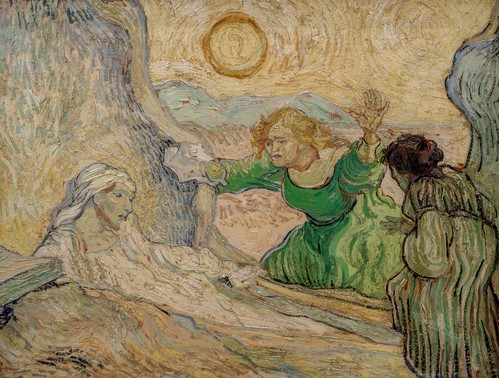
The Raising of Lazarus (1890)1 by Vincent van Gogh (1853-1890), held in the Van Gogh Museum in Amsterdam, Netherlands. Painted in May 1880, while in the asylum at Saint-Rémy-de-Provence [from 8 May 1889 to 16 May 1890]. “The attacks of mental illness, called epilepsy at that time, were to recur, and van Gogh allowed himself to be institutionalized in Saint-Rémy not far from Arles.” He would die by suicide, shooting himself in the chest on 27 July 1890. “Two days later he died calmly in the presence of Theo [his brother], who outlived him by only six months.”
For the best copy of this Meditation, with all formatting in place, click here for the PDF:
John 11 (NJB): Then Jesus lifted upj his eyes and said: Father, I thank you for hearing my prayer. 42 I myself knew that you hear me always, but I speak for the sake of all these who are standing around me, so that they may believe it was you who sent me. 43 When he had said this, he cried in a loud voice, ‘Lazarus, come out!’2
Note
We have taken our cue from the Gospels given to be heard and contemplated in Catholic churches on each of the Sundays of Lent. We have progressed from Temptation (Matthew 4) to Transfiguration (Matthew 17) to Conversation (John 4), to Conflict (John 9), and now to Death (John 11).
Seeing the Painting
First, it is unusual for us to find, as is the case here, a masterpiece (below) etched by a Master – Rembrandt van Rijn (1606-1669) whom a later Master “made his own” by painting it. Here is Rembrandt’s contemplation of John 11:41-43 (below),3 from which we have Van Gogh’s painting (above).
Note
We have taken our cue from the Gospels given to be heard and contemplated in Catholic churches on each of the Sundays of Lent. We have progressed from Temptation (Matthew 4) to Transfiguration (Matthew 17) to Conversation (John 4), to Conflict (John 9), and now to Death (John 11).
Seeing the Painting
First, it is unusual for us to find, as is the case here, a masterpiece (below) etched by a Master – Rembrandt van Rijn (1606-1669) whom a later Master “made his own” by painting it. Here is Rembrandt’s contemplation of John 11:41-43 (below),3 from which we have Van Gogh’s painting (above).
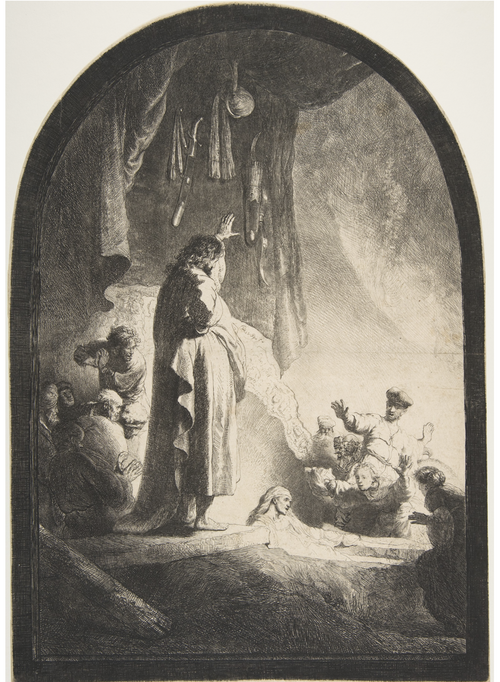
The Raising of Lazarus (1869) by Rembrandt van Rijn (1606-1669)
Second, notice how van Gogh focuses his attention on the three siblings, leaving unseen the Lord who is summoning Lazarus from the realm of the dead (vv43-44). Why would the artist leave Jesus out? Well, one thing that anyone knows who has found his or her gift is that it is not about how or why or that he or she gives that gift. It is about what happens for others when one gives it, and the joy and wonder the giver experiences watching that happen. The giver feels embarrassed to be praised (though he or she would hope to be loved and not envied), which is what Jesus meant when He said,
Matthew 5 (NJB) - 16 In the same way your light must shine in people’s sight, so that, seeing your good works, they may give praise to your Father in heaven.4
There is little doubt that van Gogh understands the effect Jesus’ action is having on the three siblings of Bethany: Lazarus and his two sisters, Mary and Martha. How would you describe the emotions that you see in each of the three? For example, is that not terror on the face and in the gestures of that one sister? For example, why are the sisters not looking at Jesus?
Third, notice also how in van Gogh’s painting, because he paints with vivid colors, we can see a red beard on Lazarus – van Gogh’s beard was red like that. The painter has identified with Lazarus, wanting to feel with his biblical brother what it felt like to be called by Christ who spoke into the dead place (sometimes people experience depression as a kind of living death, of being imprisoned in a gray space in-between): “Unbind him, and let him go free!” Remember that van Gogh, unreachable inside his tortured mind, painted this Gospel scene just two months before suicide.
Finally, think of just one of God’s masterpieces, human beings, about which Ephesians 2 writes: 10 We are God’s work of art, created in Christ Jesus for the good works which God has already designated to make up our way of life.5 Let us then consider how Jesus Christ, fully God and fully human, “made His own” that original work of art - what the Trinity made from the dust of the Earth and placed in Paradise. He was Himself a living, incarnate image and likeness of a human being, born of Mary – His “copy” (better than a painting) of the original. Jesus Christ is God’s way of being a human being, so that we could learn how to be human beings as God originally made us to be. Just because we were born human beings clearly does not mean that we are any good at it.
Quotes
St. John Henry Newman (1801-1890), Sermon 10 “On the Tears of Christ”, Parochial and Plain Sermons, Volume 3 – He [Jesus Christ] who speaks is not one whose thoughts it is easy to get possession of; that it is no light matter to put one’s self, even in part, into the position of His mind, and to state under what feelings and motives He said this or that; in a word, I wish to impress upon you, that our Saviour’s words are not of a nature to be heard once and no more, but that to understand them we must feed upon them, and live in them, as if by little and little growing into their meaning. It would be well if we understood the necessity of this more than we do.6
Pablo Neruda, “Morning” -
We go where nothing is expected
and find everything waiting there.
Matthew 5 (NJB) - 16 In the same way your light must shine in people’s sight, so that, seeing your good works, they may give praise to your Father in heaven.4
There is little doubt that van Gogh understands the effect Jesus’ action is having on the three siblings of Bethany: Lazarus and his two sisters, Mary and Martha. How would you describe the emotions that you see in each of the three? For example, is that not terror on the face and in the gestures of that one sister? For example, why are the sisters not looking at Jesus?
Third, notice also how in van Gogh’s painting, because he paints with vivid colors, we can see a red beard on Lazarus – van Gogh’s beard was red like that. The painter has identified with Lazarus, wanting to feel with his biblical brother what it felt like to be called by Christ who spoke into the dead place (sometimes people experience depression as a kind of living death, of being imprisoned in a gray space in-between): “Unbind him, and let him go free!” Remember that van Gogh, unreachable inside his tortured mind, painted this Gospel scene just two months before suicide.
Finally, think of just one of God’s masterpieces, human beings, about which Ephesians 2 writes: 10 We are God’s work of art, created in Christ Jesus for the good works which God has already designated to make up our way of life.5 Let us then consider how Jesus Christ, fully God and fully human, “made His own” that original work of art - what the Trinity made from the dust of the Earth and placed in Paradise. He was Himself a living, incarnate image and likeness of a human being, born of Mary – His “copy” (better than a painting) of the original. Jesus Christ is God’s way of being a human being, so that we could learn how to be human beings as God originally made us to be. Just because we were born human beings clearly does not mean that we are any good at it.
Quotes
St. John Henry Newman (1801-1890), Sermon 10 “On the Tears of Christ”, Parochial and Plain Sermons, Volume 3 – He [Jesus Christ] who speaks is not one whose thoughts it is easy to get possession of; that it is no light matter to put one’s self, even in part, into the position of His mind, and to state under what feelings and motives He said this or that; in a word, I wish to impress upon you, that our Saviour’s words are not of a nature to be heard once and no more, but that to understand them we must feed upon them, and live in them, as if by little and little growing into their meaning. It would be well if we understood the necessity of this more than we do.6
Pablo Neruda, “Morning” -
We go where nothing is expected
and find everything waiting there.
Thoughts
5 Jesus loved Martha and her sister and Lazarus, 6 yet when he heard that he was ill he stayed where he was for two more days.7 – We know how completely improbable it is that Jesus, who loved Lazarus, would have waited - 3 The sisters sent this message to Jesus, ‘Lord, the man you love is ill.’8 He would have left immediately for Bethany (as we would have done). Of course He would have. But He did not. Why? St. Peter Chrysologus9, a Doctor of the Church, offered this observation:
But does not this seem cruel of Christ, using Lazarus, letting him rot, so that He could make a point? Jesus Christ was never cruel like this. Christ waited because His Father told Him to do so, assuring Him: “My dearly beloved Son, we’ve got Lazarus, and we want you to help us give to him a gift. Lazarus has always felt overshadowed by You and by his sisters. We intend to make him an intimate part of one of the greatest of all Signs to be given to human beings. Wait just two more days; then go to him.”
5 Jesus loved Martha and her sister and Lazarus, 6 yet when he heard that he was ill he stayed where he was for two more days.7 – We know how completely improbable it is that Jesus, who loved Lazarus, would have waited - 3 The sisters sent this message to Jesus, ‘Lord, the man you love is ill.’8 He would have left immediately for Bethany (as we would have done). Of course He would have. But He did not. Why? St. Peter Chrysologus9, a Doctor of the Church, offered this observation:
You see how He allows death to have a foothold, he gives free rein to the grave, he permits corruption to hold sway, He refuses nothing to decay and to stench, and He grants Tartarus10 the opportunity to seize, drag, and hold him. He intends for human hope to be completely lost and for the onset of earthly despair in full force, to make the point that what He is going to do is a divine, not a human, act. But to accomplish this He remains in the same place to await Lazarus’s death, so that He might both announce that he died, and then declare that He would go to Lazarus.11
But does not this seem cruel of Christ, using Lazarus, letting him rot, so that He could make a point? Jesus Christ was never cruel like this. Christ waited because His Father told Him to do so, assuring Him: “My dearly beloved Son, we’ve got Lazarus, and we want you to help us give to him a gift. Lazarus has always felt overshadowed by You and by his sisters. We intend to make him an intimate part of one of the greatest of all Signs to be given to human beings. Wait just two more days; then go to him.”
Jesus wept; 36 and the Jews said, ‘See how much he loved him!’12 – We might have noticed how some of the people drew a conclusion as to the nature of the tears that they saw in Jesus’ eyes. We need not conclude the same. Let us instead ask Jesus – “Lord, why are you crying?”. I have learned over the long years that I am a fool when I am convinced that I know why someone is crying. I must ask the person – “Can you help me understand what those tears mean?”13
I could imagine the sorrow that Jesus was feeling when He recognized the depth of hatred for Him that the in-group and in-power group of Jewish religious leaders cultivated – John 11: 53 From that day onwards they were determined to kill him.14 It had to have been heart-breaking to Him, a long sorrow, to walk among those who, above all and quicker than anyone else (though perhaps not as quick as the demons), should have been able to recognize the Gift being given them by God. Instead, they chose to be offended by Him – it had to have been envy (the signature failing of Satan) and eventually to a murderous degree.
I could well understand why He would weep at the living death that envy causes. This was surely not the first time that Jesus thought or spoke or prayed: “Unbind them and let them go free!” Envious people lay waste to others. How often in history people have considered impressive such “power” (unable or unwilling to recognize its demonic source), praising a person who is “not afraid to be powerful”. We consider it useful to us, apparently, when such a person uses his or her power to go after “our betters”, whose “better” is an offense to us. And so, cities and nations are laid waste – the sign of Envy’s presence and its devastating power to unmake everything.
I could imagine the sorrow that Jesus was feeling when He recognized the depth of hatred for Him that the in-group and in-power group of Jewish religious leaders cultivated – John 11: 53 From that day onwards they were determined to kill him.14 It had to have been heart-breaking to Him, a long sorrow, to walk among those who, above all and quicker than anyone else (though perhaps not as quick as the demons), should have been able to recognize the Gift being given them by God. Instead, they chose to be offended by Him – it had to have been envy (the signature failing of Satan) and eventually to a murderous degree.
Envy, rooted ordinarily in a radical difficulty in trusting that God loves one uniquely and personally, moves the self-doubting person to covet what others seem to be or have. There is sadness or displeasure at the spiritual or temporal good of another. For many people, envy threatens if an atmosphere of competitiveness and comparison degenerates into an environment of stifling jealousy. Then the good of another becomes an evil to oneself, inasmuch as it seems to lessen one’s own excellence. From envy can follow hatred and resentment, calumny and detraction.15
I could well understand why He would weep at the living death that envy causes. This was surely not the first time that Jesus thought or spoke or prayed: “Unbind them and let them go free!” Envious people lay waste to others. How often in history people have considered impressive such “power” (unable or unwilling to recognize its demonic source), praising a person who is “not afraid to be powerful”. We consider it useful to us, apparently, when such a person uses his or her power to go after “our betters”, whose “better” is an offense to us. And so, cities and nations are laid waste – the sign of Envy’s presence and its devastating power to unmake everything.
Resignedly beneath the sky
The melancholy waters lie.
So blend the turrets and shadows there
That all seem pendulous in air,
While from a proud tower in the town
Death looks gigantically down.16
Death looks gigantically down.16
Jesus is not crying at the death of Lazarus (He already knows what His Father has asked Him to do, and to what astonishing effect). Rather, He is weeping at the presence of another Death, a living death, present in and emanating from those who take offense at Him. He knows how this kind of hard-heartedness will keep them from the abounding mercy of God.
John 4 (NJB):
If you only knew what God is offering
and who it is that is saying to you,
‘Give me something to drink,’
you would have been the one to ask,
and he would have given you living water. 17
Envy is the inner force of the “deplorable word”18 so famously exercised by Jadis, the White Witch, in Lewis’ The Magician’s Nephew.
[Jadis speaking to the kids] Then I spoke the Deplorable Word. A moment later I was the only living thing beneath the sun.” “But the people?” gasped Digory. “What people, boy?” asked the Queen. “All the ordinary people,” said Polly, “who’d never done you any harm. And the women, and the children, and the animals.” “Don’t you understand?” said the Queen (still speaking to Digory). “I was the Queen. They were all my people. What else were they there for but to do my will?” “It was rather hard luck on them, all the same,” said he. “I had forgotten that you are only a common boy. How should you understand reasons of State? You must learn, child, that what would be wrong for you or for any of the common people is not wrong in a great Queen such as I. The weight of the world is on our shoulders. We must be freed from all rules. Ours is a high and lonely destiny.” [Lewis, C.S., The Magician's Nephew (Chronicles of Narnia Book 1) (pp. 67-68). Kindle Edition.]
Perhaps, if we think really hard about it, we would prefer and trust the following words more than “deplorable” words:
John 10 (NJB):
10 The thief comes
only to steal and kill and destroy.
I have come
so that they may have life
and have it to the full.
11 I am the good shepherd:
the good shepherd lays down his life for his sheep.19
Prayer for the Fifth Week of Lent20
By your help, we beseech you, Lord our God,
may we walk eagerly in that same charity
with which, out of love for the world,
your Son handed himself over to death.21
Through our Lord Jesus Christ, your Son,
who lives and reigns with you in the unity of the Holy Spirit,
God, for ever and ever.22
Notes
1 For closer study of this painting: https://commons.wikimedia.org/wiki/File:The_Raising_of_Lazarus_-_Vincent_Van_Gogh.jpg. But also, see: https://www.vangoghmuseum.nl/en/collection/s0169V1962?utm_source=copilot.com. Evert van Uitert in Grove Art (Oxford): Vincent (Willem) van Gogh – “Dutch painter. His life and work are legendary in the history of late 19th- and 20th-century art. Van Gogh was active as an artist for ten years, but as a full-fledged painter only five years, during which time he produced some 1000 watercolors, drawings, and sketches and about 1250 paintings ranging from a dark, Realist style to an intense, colorful expressionistic one. … Albert Aurier in 1890 characterized him as ‘This robust and true artist, a thoroughbred with the brutal hands of a giant, the nerves of a hysterical woman, the soul of a mystic’ and said that ‘he will never be fully understood except by his brothers, the true artists…’.
2 The New Jerusalem Bible. Doubleday, 1990, p. Jn 11:41–43.
3 See: https://www.metmuseum.org/art/collection/search/391532.
2 The New Jerusalem Bible. Doubleday, 1990, p. Jn 11:41–43.
3 See: https://www.metmuseum.org/art/collection/search/391532.
7 The New Jerusalem Bible. Doubleday, 1990, p. Jn 11:5–6.
8 The New Jerusalem Bible. Doubleday, 1990, p. Jn 11:3.
9 St. Peter Chrysologus (c 380-450 CE) – The sermons for which Peter Chrysologus became famous are well known for the careful preparation of a well-prepared orator, their human sentiment and the divine fervor of a holy man. Through their examples, they also reflect the situation during that time at Ravenna, the imperial residence, an important port and agricultural center. [Studer, Basil. “Peter Chrysologus.” Encyclopedia of Ancient Christianity, edited by Angelo Di Berardino and James Hoover, translated by Joseph T. Papa et al., vol. 3, IVP Academic; InterVarsity Press, 2014, p. 159.]
10 Tartarus - Tartarus, in Greek mythology, lowest region of the underworld. The wicked (e.g., SISYPHUS, TANTALUS, and IXION) were sent to Tartarus as punishment for their sins. [Lagassé, Paul, Columbia University. The Columbia Encyclopedia, 6th ed., Columbia University Press; Sold and distributed by Gale Group, 2000.]
11 Peter Chrysologus. Selected Sermons of Saint Peter Chrysologus. Edited by Thomas P. Halton, Translated by William B. Palardy, vol. 2, The Catholic University of America Press, 2004, pp. 250–51.
8 The New Jerusalem Bible. Doubleday, 1990, p. Jn 11:3.
9 St. Peter Chrysologus (c 380-450 CE) – The sermons for which Peter Chrysologus became famous are well known for the careful preparation of a well-prepared orator, their human sentiment and the divine fervor of a holy man. Through their examples, they also reflect the situation during that time at Ravenna, the imperial residence, an important port and agricultural center. [Studer, Basil. “Peter Chrysologus.” Encyclopedia of Ancient Christianity, edited by Angelo Di Berardino and James Hoover, translated by Joseph T. Papa et al., vol. 3, IVP Academic; InterVarsity Press, 2014, p. 159.]
10 Tartarus - Tartarus, in Greek mythology, lowest region of the underworld. The wicked (e.g., SISYPHUS, TANTALUS, and IXION) were sent to Tartarus as punishment for their sins. [Lagassé, Paul, Columbia University. The Columbia Encyclopedia, 6th ed., Columbia University Press; Sold and distributed by Gale Group, 2000.]
11 Peter Chrysologus. Selected Sermons of Saint Peter Chrysologus. Edited by Thomas P. Halton, Translated by William B. Palardy, vol. 2, The Catholic University of America Press, 2004, pp. 250–51.
12 The New Jerusalem Bible. Doubleday, 1990, p. Jn 11:35–36.
13 I have often been surprised by the answer. Sometimes I am surprised when a person replies, “I don’t know why I am crying.” (Maybe it is more important that a person cries, not why.) I have certainly learned that I must ask women what their tears mean, and I do not think that it is just because I am a man. The language of tears in women seems to me a different language than the language of tears in men. Not sure, but I think so. This tentative conviction is one of my “proofs” that gender does go as deep as the soul, i.e., that souls are not genderless – not neuter “stuff”. This makes sense to me when I recall that God made man and woman with two different acts of divine will – Genesis 2 (NJB): 22 Yahweh God fashioned the rib he had taken from the man into a woman and brought her to the man.
14 The New Jerusalem Bible. Doubleday, 1990, p. Jn 11:53.
15 Downey, Michael. The New Dictionary of Catholic Spirituality, Electronic ed., Liturgical Press, 2000, pp. 249–50, at “Deadly Sins” by George P. Evans.
13 I have often been surprised by the answer. Sometimes I am surprised when a person replies, “I don’t know why I am crying.” (Maybe it is more important that a person cries, not why.) I have certainly learned that I must ask women what their tears mean, and I do not think that it is just because I am a man. The language of tears in women seems to me a different language than the language of tears in men. Not sure, but I think so. This tentative conviction is one of my “proofs” that gender does go as deep as the soul, i.e., that souls are not genderless – not neuter “stuff”. This makes sense to me when I recall that God made man and woman with two different acts of divine will – Genesis 2 (NJB): 22 Yahweh God fashioned the rib he had taken from the man into a woman and brought her to the man.
14 The New Jerusalem Bible. Doubleday, 1990, p. Jn 11:53.
15 Downey, Michael. The New Dictionary of Catholic Spirituality, Electronic ed., Liturgical Press, 2000, pp. 249–50, at “Deadly Sins” by George P. Evans.
16 Lines taken from “The City in the Sea” by Edgar Allan Poe. See some remarks about it here: https://www.eapoe.org/works/mabbott/tom1p050.htm. My emphasis.
17 The New Jerusalem Bible. Doubleday, 1990, p. Jn 4:10.
18 Paul F. Ford: “DEPLORABLE WORD, THE - A magic word that has the power to destroy all but its speaker. It is a word that Jadis [the White Witch] has learned at great personal cost, and which the great kings of Charn have long known (MN 5). Jadis herself used it to defeat her sister, even though the innocent people of Charn were destroyed as a result. Near the end of MN (15), Aslan tells the children that the people of their world may soon discover a secret as terrible as the Deplorable Word, a broad hint that there are wicked people with the power to destroy all life on earth, most likely a reference to the then newly discovered atom bomb. [Ford, Paul F., Pocket Companion to Narnia: A Guide to the Magical World of C.S. Lewis (Narnia® Book 62) (p. 105). Kindle Edition.] My emphases.
19 The New Jerusalem Bible. Doubleday, 1990, p. Jn 10:10–11.
20 Quǽsumus, Dómine Deus noster, ut in illa caritáte,
qua Fílius tuus díligens mundum morti se trádidit,
inveniámur ipsi, te opitulánte, alácriter ambulántes.
Per Dóminum.20
21 A fascinating line. The more typical wording is that “Jesus was handed over into the power of men” – the passive voice of that verb. But here the prayer insists that Jesus handed himself over, which of course squares up well with a line a few verses before this famous story about Lazarus in John 10 – 18 No one takes it [my life] from me; I lay it down of my own free will, and as I have power to lay it down, so I have power to take it up again; and this is the command I have received from my Father.21
22 The Roman Missal: Renewed by Decree of the Most Holy Second Ecumenical Council of the Vatican, Promulgated by Authority of Pope Paul VI and Revised at the Direction of Pope John Paul II. Third Typical Edition, United States Conference of Catholic Bishops, 2011, p. 256.
17 The New Jerusalem Bible. Doubleday, 1990, p. Jn 4:10.
18 Paul F. Ford: “DEPLORABLE WORD, THE - A magic word that has the power to destroy all but its speaker. It is a word that Jadis [the White Witch] has learned at great personal cost, and which the great kings of Charn have long known (MN 5). Jadis herself used it to defeat her sister, even though the innocent people of Charn were destroyed as a result. Near the end of MN (15), Aslan tells the children that the people of their world may soon discover a secret as terrible as the Deplorable Word, a broad hint that there are wicked people with the power to destroy all life on earth, most likely a reference to the then newly discovered atom bomb. [Ford, Paul F., Pocket Companion to Narnia: A Guide to the Magical World of C.S. Lewis (Narnia® Book 62) (p. 105). Kindle Edition.] My emphases.
19 The New Jerusalem Bible. Doubleday, 1990, p. Jn 10:10–11.
20 Quǽsumus, Dómine Deus noster, ut in illa caritáte,
qua Fílius tuus díligens mundum morti se trádidit,
inveniámur ipsi, te opitulánte, alácriter ambulántes.
Per Dóminum.20
21 A fascinating line. The more typical wording is that “Jesus was handed over into the power of men” – the passive voice of that verb. But here the prayer insists that Jesus handed himself over, which of course squares up well with a line a few verses before this famous story about Lazarus in John 10 – 18 No one takes it [my life] from me; I lay it down of my own free will, and as I have power to lay it down, so I have power to take it up again; and this is the command I have received from my Father.21
22 The Roman Missal: Renewed by Decree of the Most Holy Second Ecumenical Council of the Vatican, Promulgated by Authority of Pope Paul VI and Revised at the Direction of Pope John Paul II. Third Typical Edition, United States Conference of Catholic Bishops, 2011, p. 256.
Recent
Categories
Tags
Archive
2026
January
February
March
October
2025
January
March
June
October
2024
January
March
September
October
2023
March
November
2022
2021
No Comments