
Lenten Meditation, Third Sunday of Lent 2026
For the best copy of this Meditation, with all formatting in place, click here for the PDF:
Seeing the Painting
We have taken our cue from the Gospel given to be heard and contemplated in Catholic churches on each of the Sundays of Lent. We have progressed from Temptation (Matthew 4) to Transfiguration (Matthew 17) and now to Conversation (John 4).
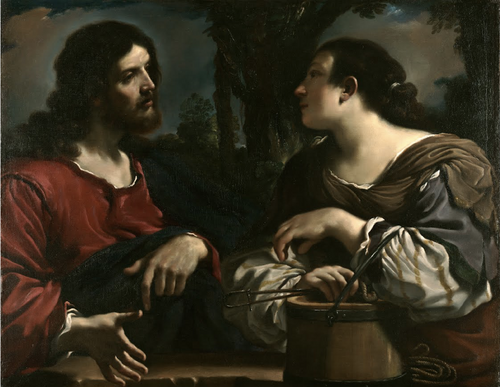
Did you notice how Guercino zooms in on the two people such that where this conversation is happening (at Jacob’s well) is not nearly as important as who is there and what is happening in their conversation? Nearly always this scene is called “the woman at the well” or some variant of that. Guercino calls his dramatic painting Christ and the Woman of Samaria, as if the space between them is the location that matters here.
Notice the intensity of the connection between the two. We might ask, at what point in the conversation has Guercino “stopped” the text, zooming in on it, so that we do not miss the moment that he considers the most important. At which verse has our artist stopped us? I think that it is here (you may decide differently):
We have taken our cue from the Gospel given to be heard and contemplated in Catholic churches on each of the Sundays of Lent. We have progressed from Temptation (Matthew 4) to Transfiguration (Matthew 17) and now to Conversation (John 4).
Did you notice how Guercino zooms in on the two people such that where this conversation is happening (at Jacob’s well) is not nearly as important as who is there and what is happening in their conversation? Nearly always this scene is called “the woman at the well” or some variant of that. Guercino calls his dramatic painting Christ and the Woman of Samaria, as if the space between them is the location that matters here.
John O’Donohue (1956-2008) - While our culture is all gloss and pace on the outside, within it is too often haunted and lost. The commercial edge of so-called “progress” has cut away a huge region of human tissue and webbing that held us in communion with one another. We have fallen out of belonging. Consequently, when we stand before crucial thresholds in our lives, we have no rituals to protect, encourage, and guide us as we cross over into the unknown. For such crossings we need to find new words.3 [My emphasis.]
Notice the intensity of the connection between the two. We might ask, at what point in the conversation has Guercino “stopped” the text, zooming in on it, so that we do not miss the moment that he considers the most important. At which verse has our artist stopped us? I think that it is here (you may decide differently):
John 4 (NJB): 25 The woman said to him, ‘I know that Messiah—that is, Christ—is coming; and when he comes, he will explain everything.’ 26 Jesus said, ‘That is who I am, I who speak to you.’4
The palpable5 connection we cannot miss. It is not a connection of words, as if the main point is that Jesus is talking and the other is listening and understanding what is being said to her. No. The connection here is about souls encountering each other, about insides touching, with the words playing their part, gestures playing their part, what each face is revealing essential. Have you noticed how friends, close friends at their “closest” moments, have moved beyond the words? They are mutually dwelling in their connection and words would be an irritating intrusion. Is it not obvious that Jesus and the woman are within each other, not touching (but close) but closer than touching?
Sometimes afraid of reunion,
sometimes of separation.
You and I, so fond of the notion
of a you and an I, should live as though
we had never heard of those pronouns.6
Quotes
Alexander Schmemann (1921-1983) - The triumph of sin, the main sign of its rule over the world, is division, opposition, separation, hatred. Therefore, the first break through this fortress of sin is forgiveness: the return to unity, solidarity, love. To forgive is to put between me and my “enemy” the radiant forgiveness of God Himself. To forgive is to reject the hopeless “dead-ends” of human relations and to refer them to Christ. Forgiveness is truly a “breakthrough” of the Kingdom into this sinful and fallen world.7
St. John Chrysostom (347-407 CE) – Moreover, the woman at once believed, and appeared wiser than Nicodemus; indeed, not only wiser, but even stronger. For, though he heard countless things of this kind, he neither summoned any other person to Christ, nor did he himself speak freely of Him; while she engaged in apostolic work, spreading the good news to all, and calling them to Jesus, drawing to Him a whole city from outside the faith.8
Bishop Erik Varden9 on “Caritas” (12 February 2026): “When we consider the world we live in now, and hear the political message spouted in various quarters, it is striking that the principle, ‘every stranger is an enemy’, has gained fresh currency. The infection is spreading. Many refuse to be vaccinated.”
Thoughts
John 4: 39 Many Samaritans of that town believed in him on the strength of the woman’s words of testimony, ‘He told me everything I have done.’
Bishop Erik Varden9 on “Caritas” (12 February 2026): “When we consider the world we live in now, and hear the political message spouted in various quarters, it is striking that the principle, ‘every stranger is an enemy’, has gained fresh currency. The infection is spreading. Many refuse to be vaccinated.”
Thoughts
St. Ephrem the Syrian (306-373 CE)
O, to you, [Samaritan] woman in whom I see
a wonder as great as in Mary!
For she from within her womb
in Bethlehem brought forth his body as a child,
but you by your mouth made him manifest
as an adult in Shechem, the town of His father’s household.
Blessed are you, O woman, who brought forth by your mouth
light for those in darkness.10
John 4: 39 Many Samaritans of that town believed in him on the strength of the woman’s words of testimony, ‘He told me everything I have done.’
Years ago, it became clear to me that inside of every grace that God gives to a person hides a mission.
What does this mean? Well, it means that God gives a person a grace11 so that he or she may be grace-full toward certain other people, and sometimes toward a very particular other person.
A divine grace is only half-received when you or I receive it; it is even less than half understood.
To put this another way, I have learned that one of God’s favorite habits is to give a grace to a person who has not asked for it, so that he or she might notice someone (s) who has been asking for that grace. God loves it when we pay attention in this way. And noticing that we have what that person needs, we can, like God, give it freely to that person.
When we do freely pass on what we have received, we “complete” the grace, its essentially co-operative13 nature. We fully receive the grace that we were given (was entrusted to us) when, and because, that other person (s) has received it through us. Joy is kindled in both giver and receiver, such that a giver may honestly feel that he or she is the receiver. Divine grace is superabundant like this.
What does this mean? Well, it means that God gives a person a grace11 so that he or she may be grace-full toward certain other people, and sometimes toward a very particular other person.
A divine grace is only half-received when you or I receive it; it is even less than half understood.
To put this another way, I have learned that one of God’s favorite habits is to give a grace to a person who has not asked for it, so that he or she might notice someone (s) who has been asking for that grace. God loves it when we pay attention in this way. And noticing that we have what that person needs, we can, like God, give it freely to that person.
Ram Dass (1985): Operating from the model of the separate self, fear and caution may be the first responses we notice that block the spontaneous expression of our innate generosity. In infancy, when the foundation stones of ego are developed and the world seems very big, our survival mechanisms are called into play very quickly. We feel powerless and vulnerable, and because these ideas are learned emotionally, before reason and perspective are fully operating, they may be surprisingly resistant to change as we grow older. So perhaps we are a little wary of the world around us. However much we might wish to reach out, a habit of self-protectiveness buried within may still hold us back. “Keep the doors locked and we’ll be secure,” says the ego. Our heart responds, “But I’m not happy like that.” To which the ego replies, “Better safe than sorry.”12
When we do freely pass on what we have received, we “complete” the grace, its essentially co-operative13 nature. We fully receive the grace that we were given (was entrusted to us) when, and because, that other person (s) has received it through us. Joy is kindled in both giver and receiver, such that a giver may honestly feel that he or she is the receiver. Divine grace is superabundant like this.
A “completed” grace is a relationship that happens between persons, because of the grace that is shared. We ask for things; God gives us each other. Jesus was perfectly clear about how this works:
Prayer for the Third Sunday of Lent
O God, author of every mercy and of all goodness,
who in fasting, prayer and almsgiving
have shown us a remedy for sin,
look graciously on this confession of our lowliness,
that we, who are bowed down by our conscience,
may always be lifted up by your mercy.15
John 15 (NJB):
11 I have told you this
so that my own joy may be in you
and your joy be complete.
12 This is my commandment:
love one another,
as I have loved you.14
Prayer for the Third Sunday of Lent
O God, author of every mercy and of all goodness,
who in fasting, prayer and almsgiving
have shown us a remedy for sin,
look graciously on this confession of our lowliness,
that we, who are bowed down by our conscience,
may always be lifted up by your mercy.15
Notes
1 To study the painting: https://artsandculture.google.com/asset/christ-and-the-woman-of-samaria-guercino-giovanni-francesco-barbieri/5gGmwtZxX7mavg.
2 Grove Art Online (Oxford), Nicholas Turner on Guercino: Italian painter and draughtsman. He was one of the leading painters of the Bolognese school and one of the most accomplished draughtsmen of the Italian Baroque. His paintings show a command of subtle effects of light and dark, with the figures revealing a wide variety of gesture and facial expression, the result of the artist’s good grasp of human psychology.
3 O'Donohue, John. To Bless the Space Between Us: A Book of Blessings (2008) from the Introduction. Kindle Edition. Wikipedia: John O'Donohue (1 January 1956 – 4 January 2008) was an Irish poet, author, priest, and Hegelian philosopher. He was a native Irish speaker, and as an author is best known for popularizing Celtic spirituality.
2 Grove Art Online (Oxford), Nicholas Turner on Guercino: Italian painter and draughtsman. He was one of the leading painters of the Bolognese school and one of the most accomplished draughtsmen of the Italian Baroque. His paintings show a command of subtle effects of light and dark, with the figures revealing a wide variety of gesture and facial expression, the result of the artist’s good grasp of human psychology.
3 O'Donohue, John. To Bless the Space Between Us: A Book of Blessings (2008) from the Introduction. Kindle Edition. Wikipedia: John O'Donohue (1 January 1956 – 4 January 2008) was an Irish poet, author, priest, and Hegelian philosopher. He was a native Irish speaker, and as an author is best known for popularizing Celtic spirituality.
4 The New Jerusalem Bible. Doubleday, 1990, p. Jn 4:25–26.
5 The Oxford English Dictionary at “palpable” – 1.a. – 1395 – That may be touched, felt, or handled; perceptible by the sense of touch; tangible.
6 Rumi: The Big Red Book – The Great Masterpiece Celebrating Mystical Love and Friendship (2010), translated by Coleman Barks, page 505.
7 Schmemann, Alexander. Great Lent. St Vladimir’s Seminary Press, 1969, p. 28. And, Schmemann, Alexander (1921–83) Orthodox priest and theologian. Born in Estonia of Russian exiles, Schmemann studied at Russian and French schools in Paris, completing theological studies at the Institut St-Serge, and gaining a doctorate at the Sorbonne. He became a priest in 1946 and taught church history at the Institut St-Serge before moving to New York in 1951. He taught at St Vladimir’s Orthodox Theological Seminary, serving as dean from 1962 until his death. He also taught and lectured at many non-Orthodox universities and seminaries.
5 The Oxford English Dictionary at “palpable” – 1.a. – 1395 – That may be touched, felt, or handled; perceptible by the sense of touch; tangible.
6 Rumi: The Big Red Book – The Great Masterpiece Celebrating Mystical Love and Friendship (2010), translated by Coleman Barks, page 505.
7 Schmemann, Alexander. Great Lent. St Vladimir’s Seminary Press, 1969, p. 28. And, Schmemann, Alexander (1921–83) Orthodox priest and theologian. Born in Estonia of Russian exiles, Schmemann studied at Russian and French schools in Paris, completing theological studies at the Institut St-Serge, and gaining a doctorate at the Sorbonne. He became a priest in 1946 and taught church history at the Institut St-Serge before moving to New York in 1951. He taught at St Vladimir’s Orthodox Theological Seminary, serving as dean from 1962 until his death. He also taught and lectured at many non-Orthodox universities and seminaries.
8 John Chrysostom. Commentary on Saint John the Apostle and Evangelist: Homilies 1–47. Translated by Thomas Aquinas Goggin, vol. 33, The Catholic University of America Press, 1957, p. 314.
9 See his website: https://coramfratribus.com. Erik Varden, OCSO is a monk (Trappist) and bishop, born in Norway in 1974. In 2002, after ten years at the University of Cambridge, he joined Mount Saint Bernard Abbey in Charnwood Forest. Pope Francis named him bishop of Trondheim in 2019.
10 Wilken, Robert Louis, et al., editors. John: Interpreted by Early Christian and Medieval Commentators. Translated by Michael A. Thomas and Bryan A. Stewart, William B. Eerdmans Publishing Company, 2018, p. 119.
9 See his website: https://coramfratribus.com. Erik Varden, OCSO is a monk (Trappist) and bishop, born in Norway in 1974. In 2002, after ten years at the University of Cambridge, he joined Mount Saint Bernard Abbey in Charnwood Forest. Pope Francis named him bishop of Trondheim in 2019.
10 Wilken, Robert Louis, et al., editors. John: Interpreted by Early Christian and Medieval Commentators. Translated by Michael A. Thomas and Bryan A. Stewart, William B. Eerdmans Publishing Company, 2018, p. 119.
11 “a grace” – I do not like referring to divine grace in this way, as if it were some sort of “thing”, a kind of “object” that God possesses but who hands it over to me so that now I can possess it. I find it difficult to express what I mean. But what I am straining towards in the expression “a grace” is an experience a person has of having suddenly become capable where before he or she had been incapable. (What the tradition has called “helping grace” or “actual” versus “sanctifying” grace.)
12 Dass, Ram and Gorman, Paul. How Can I Help?: Stories and Reflections on Service (pp. 23-24). Kindle Edition.
13 The Oxford English Dictionary at “cooperative” – 1. – 1603 – Of or relating to cooperation; having the quality or function of cooperating; that works together, or with another or others, towards the same end, purpose, or effect; collaborative. Also: that complies with an authority, order, request, etc., or is willing to be of assistance.
St. John Chrysostom (347-407 CE) - After he had spoken with them and calmed them sufficiently, he added, These things I have spoken to you, that my joy may be in you, and that your joy may be full (15:11). It is as if he said, “These things I have spoken to you so that you might not be separated from me or that you might not cut short your race. You were rejoicing in me greatly, but now a deep sadness has settled upon you. I will therefore remove this so that your joy may reach the finish line and that you might see that the events occurring now are not a cause for grief but for joy. I saw that you were offended, but I did not hold you in contempt … but in order that your joy may be full, these things I have spoken to you. This is my commandment, that you love one another as I have loved you” (15:11–12). Do you see that God’s love is intertwined with our own? That it is connected like a chain?13 [My italics.]
12 Dass, Ram and Gorman, Paul. How Can I Help?: Stories and Reflections on Service (pp. 23-24). Kindle Edition.
13 The Oxford English Dictionary at “cooperative” – 1. – 1603 – Of or relating to cooperation; having the quality or function of cooperating; that works together, or with another or others, towards the same end, purpose, or effect; collaborative. Also: that complies with an authority, order, request, etc., or is willing to be of assistance.
St. John Chrysostom (347-407 CE) - After he had spoken with them and calmed them sufficiently, he added, These things I have spoken to you, that my joy may be in you, and that your joy may be full (15:11). It is as if he said, “These things I have spoken to you so that you might not be separated from me or that you might not cut short your race. You were rejoicing in me greatly, but now a deep sadness has settled upon you. I will therefore remove this so that your joy may reach the finish line and that you might see that the events occurring now are not a cause for grief but for joy. I saw that you were offended, but I did not hold you in contempt … but in order that your joy may be full, these things I have spoken to you. This is my commandment, that you love one another as I have loved you” (15:11–12). Do you see that God’s love is intertwined with our own? That it is connected like a chain?13 [My italics.]
14 The New Jerusalem Bible. Doubleday, 1990, p. Jn 15:11–12.
15 Deus, ómnium misericordiárum et totíus bonitátis auctor,
qui peccatórum remédia in ieiúniis,
oratiónibus et eleemósynis demonstrásti,
hanc humilitátis nostræ confessiónem propítius intuére,
ut, qui inclinámur consciéntia nostra,
tua semper misericórdia sublevémur.
Per Dóminum.15
15 Deus, ómnium misericordiárum et totíus bonitátis auctor,
qui peccatórum remédia in ieiúniis,
oratiónibus et eleemósynis demonstrásti,
hanc humilitátis nostræ confessiónem propítius intuére,
ut, qui inclinámur consciéntia nostra,
tua semper misericórdia sublevémur.
Per Dóminum.15
Posted in Lenten Meditations
Recent
Categories
Tags
Archive
2026
January
February
March
October
2025
January
March
June
October
2024
January
March
September
October
2023
March
November
2022
2021
2 Comments
I love in the painting the beauty of the woman expressing the transforming by Jesus. That long dialogue in the Gospel condensed to a snapshot.Also the total focus on each other.
So lovely.
nI’m sure that many, who hold friendship as the great blessing were affected by the quote on shared grace,
n“we ask for things: God gives us each other.
nBut l also enjoyed your footnotes on helping grace; defining it, not as a thing, but rather an experience of suddenly becoming capable.
nBeautiful and helpful messages