
Advent Meditation 2025, Week 3
Advent Meditation, Third Week of Advent 2025
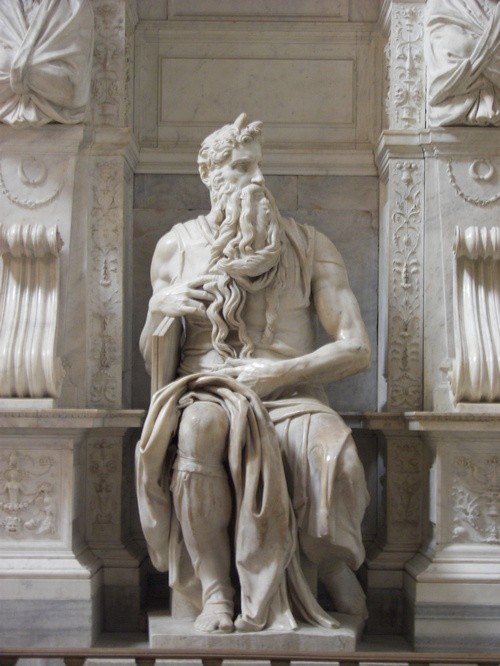
Because the biblical text, Psalm 90, that lies behind the text of Isaac Watts (below) is one attributed not to David but to Moses, the only one of the 150 Psalms that is attributed to Moses, we have chosen the most famous image of Moses – this sculpture that Michelangelo “found” inside a block of Carrara marble.3
Notice the two stone tablets (the Ten Commandments) tucked in on his right side. Michelangelo is showing us Moses when he has just returned from his second experience of being with God on Mount Sinai. This second time, God’s divine closeness to Moses caused Moses’ face to be alight with the divine Light! (The supposed “horns” on top of Moses’ head are the sculptor’s effort to express in marble two “radiant beams” of light.)
Those tablets are the second set. Moses had smashed the first set upon coming down from the mountain the first time, only to find his refractory, frustrating, foolish people worshipping a golden calf (see Exodus 32). He would pray, and God would invite Moses up onto the mountain a second time (Exodus 34). It is only when he comes down the mountain from this second visit with God that his face was so bright with divine Light that it scared everyone. Notice that Moses has those (unbroken) tablets tucked away, concerned about sharing something so precious with a people too easily making a mess of things.
Notice the two stone tablets (the Ten Commandments) tucked in on his right side. Michelangelo is showing us Moses when he has just returned from his second experience of being with God on Mount Sinai. This second time, God’s divine closeness to Moses caused Moses’ face to be alight with the divine Light! (The supposed “horns” on top of Moses’ head are the sculptor’s effort to express in marble two “radiant beams” of light.)
Exodus 34 (NJB): 29 When Moses came down from Mount Sinai with the two tablets of the Testimony in his hands, as he was coming down the mountain, Moses did not know that the skin of his face was radiant because he had been talking to God. 30 And when Aaron and all the Israelites saw Moses, the skin on his face was so radiant that they were afraid to go near him.4
Those tablets are the second set. Moses had smashed the first set upon coming down from the mountain the first time, only to find his refractory, frustrating, foolish people worshipping a golden calf (see Exodus 32). He would pray, and God would invite Moses up onto the mountain a second time (Exodus 34). It is only when he comes down the mountain from this second visit with God that his face was so bright with divine Light that it scared everyone. Notice that Moses has those (unbroken) tablets tucked away, concerned about sharing something so precious with a people too easily making a mess of things.
NOTE: For the best copy of this Meditation, with all formatting in place, click here for the PDF:
The Biblical Text Behind the Text (below)
Psalm 90:1-4 (NJB) -
On Human Frailty
Prayer Of Moses, man of God
1 Lord, you have been our refuge
from age to age.
2 Before the mountains were born,
before the earth and the world came to birth,
from eternity to eternity you are God.
3 You bring human beings to the dust,
by saying, ‘Return, children of Adam.’
4 A thousand years are to you
like a yesterday which has passed,
like a watch of the night.5
…
Derek Kidner on Psalm 90 - Only Isaiah 40 can compare with this psalm for its presentation of God’s grandeur and eternity over against the frailty of man. But while Isaiah is comforting, the Psalm is chastened and sobering, even though the clouds disperse in the final prayer. A closer companion to the poem in some respects is Genesis 1–3, on which the psalmist evidently meditates … In an age which was readier than our own to reflect on mortality and judgment, this Psalm was an appointed reading (with 1 Cor. 15) at the burial of the dead: a rehearsal of the facts of death and life which, if it was harsh at such a moment, wounded in order to heal. In the paraphrase by Isaac Watts, ‘O God, our help in ages past’, it has established itself as a prayer supremely matched to times of crisis.6Some Musical Versions of the Following Text
Martin Neary & Martin Baker and the Westminster Abbey Choir, Favorite Hymns from Westminster Abbey (released 2010); Sir Stephen Cleobury & Richard Farnes and the Choir of King’s College Cambridge, The World of Favorite Hymns (released 1986); John Rutter and the Cambridge Singers, Sing, Ye Heavens: Hymns of All Time (released 2000).
Text
Isaac Watts (1674-1748)7, “O God, Our Help in Ages Past” (1719)
1. Our God, our help in ages past,
Our hope for years to come,
Our shelter from the stormy blast,
And our eternal home:
2. Under the shadow of your throne
Your saints have dwelt secure;
Sufficient is your arm alone,
And our defense is sure.
3. Before the hills in order stood
Or Earth received her frame,
From everlasting you are God,
To endless years the same.
4. A thousand ages in your sight
Are like an evening gone,
Short as the watch that ends the night
Before the rising sun.
5. Time, like an ever-rolling stream,
Bears all its sons away;
They fly, forgotten, as a dream
Dies at the op’ning day.
6. Like flow’ry fields the nations stand,
Pleased with the morning light;
The flow’rs beneath the mower’s hand
Lie with’ring ere ’tis night.
7. Our God, our help in ages past,
Our hope for years to come,
Be thou our guard while troubles last
And our eternal home.
A Close Reading of the Text
Moses – Remember that Watts formed this hymn from Psalm 90. This suggests that we might fruitfully consider this hymn as if we were hearing Moses sing it, the words of which he might have taught some of his closest companions, when he was on Mount Nebo and so near his death.8
Our God, our help in ages past, Our hope for years to come – We first notice how the title of this famous hymn begins with “O God…” when in fact the opening line of the hymn reads “Our God…”. If we use the interjection “O”, then we express the otherness of God, who is a source of awe to us, and because of whom we cry out.
The Oxford English Dictionary at “O” – 2. - Old English – Expressing (according to intonation) appeal, surprise, lament, etc. Now chiefly poetic and rhetorical. Used mainly in imperative, optative, or exclamatory sentences or phrases, as in O take me back again!, O for another glimpse of it!, O the pity of it!, O dear!; often also emphatically in O yes, O no, O indeed, etc.
But the first line reads “Our God”, where what stands out is not the otherness of God – God as God – but the relationship with God that we cherish, something that Jesus Christ “won” for us through His life and death and resurrection and ascension. We have been granted direct access to the Father, so that we can say “our Father”. And lest we overlook the relationship (what our “redemption” means), Watts deploys four times the possessive pronoun “our” in the first four lines!
John 17 (NJB):
7 Now at last they have recognized
that all you have given me comes from you
8 for I have given them
the teaching you gave to me,
and they have indeed accepted it
and know for certain that I came from you,
and have believed that it was you who sent me.9
The way Watts structures the two opening lines places him, and us with him, at a center point of Time (in medias res: “in the middle of proceedings; into the midst of affairs”). From this point, the Present, we consider the reality of God in the Past even as we consider the Future with eyes opened by hope. We are like the Roman god of the gate/door that has two faces: one face looking inward (to the Past); one face looking outward (to the Future).10
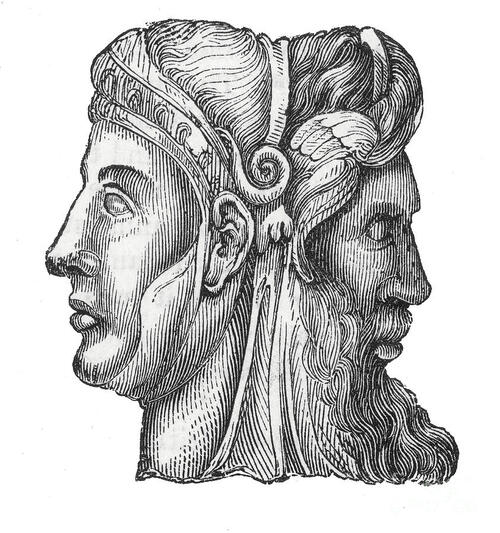
In other words, Watts argues a connection between a Past of “help” and a Future of “hope” only when we have recognized how God was at work in our Past –
If we consider the Past, even our very personal Past, as “everything that happened”, then we can get ambushed by lacerating memories, which can bind us as if by an evil enchantment,12 holding our attention on the sorrows in our Past rather than on the Blessing – the “holy Mystery” - that was alive in our Past too: a Light that shone in the darkness, which that darkness could not overcome or comprehend.
Sufficient is your arm alone, And our defense is sure – The adjective “sufficient” is an interesting choice, because it can mean different things. Let’s take a look. The word “alone” in line three rhymes with “throne” in line one. This suggests that the “defense” that we expect from God “our help in ages past” is to be exercised from Heaven where His arm is, from the “throne” where the Son sits at the right hand of the Father. And so we look upwards as we pray. But God is no longer “close” in the way Jesus was when He walked among us, the God-man, when He directly commanded evil spirits to depart, when He compelled Death itself to obey His ”sufficient” command: “Unbind him and let him go free,” He spoke before the tomb of Lazarus. This suggests that the meaning of “sufficient” used in this stanza two is this one:
Jeremiah 29 (NJB): 11 Yes, I know what plans I have in mind for you, Yahweh declares, plans for peace, not for disaster, to give you a future and a hope. 12 When you call to me and come and pray to me, I shall listen to you. 13 When you search for me, you will find me; when you search wholeheartedly for me, 14 I shall let you find me (Yahweh declares. I shall restore your fortunes and gather you in from all the nations and wherever I have driven you, Yahweh declares. I shall bring you back to the place from which I exiled you).11
If we consider the Past, even our very personal Past, as “everything that happened”, then we can get ambushed by lacerating memories, which can bind us as if by an evil enchantment,12 holding our attention on the sorrows in our Past rather than on the Blessing – the “holy Mystery” - that was alive in our Past too: a Light that shone in the darkness, which that darkness could not overcome or comprehend.
Anne Lamott (1954 -): “Forgiveness is giving up all hope of having had a better past.”
Vaclav Havel (1936-2011; first President of the Czech Republic, 1989-1992): “The kind of hope I often think about (especially in situations that are particularly hopeless, such as prison) I understand above all as a state of mind, not a state of the world. Either we have hope within us or we don’t; it’s a dimension of the soul; it’s not essentially dependent on some particular observation of the world or an estimate of the situation. Hope is not prognostication.13 It is an orientation of the spirit, an orientation of the heart; it transcends the world that is immediately experienced and is anchored somewhere beyond its horizons. Hope, in this deep and powerful sense, is not the same as joy that things are going well, or willingness to invest in enterprises that are obviously headed for early success, but, rather, an ability to work for something because it is good, not just because it stands a chance to succeed.”
Sufficient is your arm alone, And our defense is sure – The adjective “sufficient” is an interesting choice, because it can mean different things. Let’s take a look. The word “alone” in line three rhymes with “throne” in line one. This suggests that the “defense” that we expect from God “our help in ages past” is to be exercised from Heaven where His arm is, from the “throne” where the Son sits at the right hand of the Father. And so we look upwards as we pray. But God is no longer “close” in the way Jesus was when He walked among us, the God-man, when He directly commanded evil spirits to depart, when He compelled Death itself to obey His ”sufficient” command: “Unbind him and let him go free,” He spoke before the tomb of Lazarus. This suggests that the meaning of “sufficient” used in this stanza two is this one:
The Oxford English Dictionary at “sufficient” – 1.b. - Const. for: - 1.b.i. - c1380 – = to furnish means or material for, to supply, to provide for the performance of (a thing).
In other words, the “sufficient” means for our defense in this complicated world comes not from the “other” world, from the “throne” of God, but from within each of us into whom the Holy Spirit has been poured already:
Romans 5:1-5 (NJB): 1 So then, now that we have been justified by faith, we are at peace with God through our Lord Jesus Christ; 2 it is through him, by faith, that we have been admitted into God’s favour in which we are living, and look forward exultantly to God’s glory. 3 Not only that; let us exult, too, in our hardships, understanding that hardship develops perseverance, 4 and perseverance develops a tested character, something that gives us hope, 5 and a hope which will not let us down, because the love of God has been poured into our hearts by the Holy Spirit which has been given to us.14
In other words, “our defense is sure” because the power to defend ourselves is already given within us, but we must learn how to understand the nature of that power, and how to trust it, to rely on it. This is what St. Paul is trying to help us see here:
2 Corinthians 12:7-10 (NJB): 7 Wherefore, so that I should not get above myself, I was given a thorn in the flesh, a messenger from Satan to batter me and prevent me from getting above myself. 8 About this, I have three times pleaded with the Lord that it might leave me; 9 but he has answered me, ‘My grace is enough [sufficient] for you: for power is at full stretch in weakness.’ It is, then, about my weaknesses that I am happiest of all to boast, so that the power of Christ may rest upon me; 10 and that is why I am glad of weaknesses, insults, constraints, persecutions and distress for Christ’s sake. For it is when I am weak that I am strong.15
An Advent Prayer
The Collect prayer taken from the Mass for the Third Sunday of Advent, year A.
O God, who see how your people
faithfully await the feast of our Lord’s Nativity,
enable us, we pray,
to attain the joys of so great a salvation
and to celebrate them always
with solemn worship and glad rejoicing.16
faithfully await the feast of our Lord’s Nativity,
enable us, we pray,
to attain the joys of so great a salvation
and to celebrate them always
with solemn worship and glad rejoicing.16
Notes
1 Grove Art (Oxford) “Michelangelo (Buonarroti)” by Anthony Hughes and Caroline Elam – “Italian sculptor, painter, draughtsman and architect. The elaborate exequies held in Florence after Michelangelo’s death celebrated him as the greatest practitioner of the three visual arts of sculpture, painting and architecture and as a respected poet. He is a central figure in the history of art: one of the chief creators of the Roman High Renaissance, and the supreme representative of the Florentine valuation of disegno (see Disegno e colore). As a poet and a student of anatomy, he is often cited as an example of the ‘universal genius’ supposedly typical of the period.”
2 See: https://commons.wikimedia.org/wiki/File:Michelangelo's_Moses_(Rome).jpg.
3 Britannica: “The most well-known metamorphic rocks used in sculpture are the marbles, which are recrystallized limestones. Italian Carrara marble, the best known, was used by Roman and Renaissance sculptors, especially Michelangelo, and is still widely used. The best-known varieties used by Greek sculptors, with whom marble was more popular than any other stone, are Pentelic—from which the Parthenon and its sculpture are made—and Parian.”
4 The New Jerusalem Bible (New York; London; Toronto; Sydney; Auckland: Doubleday, 1990), Ex 34:29–30.
2 See: https://commons.wikimedia.org/wiki/File:Michelangelo's_Moses_(Rome).jpg.
3 Britannica: “The most well-known metamorphic rocks used in sculpture are the marbles, which are recrystallized limestones. Italian Carrara marble, the best known, was used by Roman and Renaissance sculptors, especially Michelangelo, and is still widely used. The best-known varieties used by Greek sculptors, with whom marble was more popular than any other stone, are Pentelic—from which the Parthenon and its sculpture are made—and Parian.”
4 The New Jerusalem Bible (New York; London; Toronto; Sydney; Auckland: Doubleday, 1990), Ex 34:29–30.
5 The New Jerusalem Bible (New York; London; Toronto; Sydney; Auckland: Doubleday, 1990), Ps 90: title–6.
6 Derek Kidner, Psalms 73–150: An Introduction and Commentary, vol. 16 of Tyndale Old Testament Commentaries (Downers Grove, IL: InterVarsity Press, 1975), 359.
7 From Hymnary.org at “Isaac Watts” – “Isaac Watts was the son of a schoolmaster, and was born in Southampton, July 17, 1674. He is said to have shown remarkable precocity in childhood, beginning the study of Latin, in his fourth year, and writing respectable verses at the age of seven. At the age of sixteen, he went to London to study in the Academy of the Rev. Thomas Rowe, an Independent minister. In 1698, he became assistant minister of the Independent Church, Berry St., London. In 1702, he became pastor. In 1712, he accepted an invitation to visit Sir Thomas Abney, at his residence of Abney Park, and at Sir Thomas' pressing request, made it his home for the remainder of his life. It was a residence most favourable for his health, and for the prosecution of his literary labours. He did not retire from ministerial duties, but preached as often as his delicate health would permit.”
6 Derek Kidner, Psalms 73–150: An Introduction and Commentary, vol. 16 of Tyndale Old Testament Commentaries (Downers Grove, IL: InterVarsity Press, 1975), 359.
7 From Hymnary.org at “Isaac Watts” – “Isaac Watts was the son of a schoolmaster, and was born in Southampton, July 17, 1674. He is said to have shown remarkable precocity in childhood, beginning the study of Latin, in his fourth year, and writing respectable verses at the age of seven. At the age of sixteen, he went to London to study in the Academy of the Rev. Thomas Rowe, an Independent minister. In 1698, he became assistant minister of the Independent Church, Berry St., London. In 1702, he became pastor. In 1712, he accepted an invitation to visit Sir Thomas Abney, at his residence of Abney Park, and at Sir Thomas' pressing request, made it his home for the remainder of his life. It was a residence most favourable for his health, and for the prosecution of his literary labours. He did not retire from ministerial duties, but preached as often as his delicate health would permit.”
8 The death of Moses is narrated in Deuteronomy 34: 7 Moses was a hundred and twenty years old when he died, his eye undimmed, his vigour unimpaired. 8 The Israelites wept for Moses on the Plains of Moab for thirty days. [The New Jerusalem Bible (New York; London; Toronto; Sydney; Auckland: Doubleday, 1990), Dt 34:7–8.]
9 The New Jerusalem Bible (New York; London; Toronto; Sydney; Auckland: Doubleday, 1990), Jn 17:7–8.
10 An AI summary: “Janus is the ancient Roman god of beginnings, transitions, doorways, and endings, famously depicted with two faces looking in opposite directions, symbolizing past and future, entry and exit. The month of January is named for him, and he presided over war and peace, with the Temple of Janus's gates open in war and closed in peace.”
11 The New Jerusalem Bible (New York; London; Toronto; Sydney; Auckland: Doubleday, 1990), Je 29:11–14.
9 The New Jerusalem Bible (New York; London; Toronto; Sydney; Auckland: Doubleday, 1990), Jn 17:7–8.
10 An AI summary: “Janus is the ancient Roman god of beginnings, transitions, doorways, and endings, famously depicted with two faces looking in opposite directions, symbolizing past and future, entry and exit. The month of January is named for him, and he presided over war and peace, with the Temple of Janus's gates open in war and closed in peace.”
11 The New Jerusalem Bible (New York; London; Toronto; Sydney; Auckland: Doubleday, 1990), Je 29:11–14.
12 The Oxford English Dictionary at “to enchant” – 2.a. - c1374–1678 - figurative. To influence irresistibly or powerfully, as if by a charm; to hold spellbound; in bad sense, to delude, befool. Obsolete.
13 The Oxford English Dictionary at “to prognosticate” – 1.b. - c1487 – transitive. Of a person: to know or tell of beforehand; to have previous knowledge of, to presage; to foretell, predict, prophesy, forecast.”
14 The New Jerusalem Bible (New York; London; Toronto; Sydney; Auckland: Doubleday, 1990), Ro 5:1–5.
15 The New Jerusalem Bible (New York; London; Toronto; Sydney; Auckland: Doubleday, 1990), 2 Co 12:7–10.
16 “Solemn … glad” - I am reminded of a remark by C.S. Lewis, Letters to Malcolm, chapter 17: “Dance and game are frivolous, unimportant down here; for ‘down here’ is not their natural place. Here, they are a moment’s rest from the life we were placed here to live. But in this world, everything is upside down. That which, if it could be prolonged here, would be a truancy, is likest that which in a better country is the End of ends. Joy is the serious business of Heaven. [Lewis, C. S., A Mind Awake: An Anthology of C. S. Lewis (p. 11). Kindle Edition.
13 The Oxford English Dictionary at “to prognosticate” – 1.b. - c1487 – transitive. Of a person: to know or tell of beforehand; to have previous knowledge of, to presage; to foretell, predict, prophesy, forecast.”
14 The New Jerusalem Bible (New York; London; Toronto; Sydney; Auckland: Doubleday, 1990), Ro 5:1–5.
15 The New Jerusalem Bible (New York; London; Toronto; Sydney; Auckland: Doubleday, 1990), 2 Co 12:7–10.
16 “Solemn … glad” - I am reminded of a remark by C.S. Lewis, Letters to Malcolm, chapter 17: “Dance and game are frivolous, unimportant down here; for ‘down here’ is not their natural place. Here, they are a moment’s rest from the life we were placed here to live. But in this world, everything is upside down. That which, if it could be prolonged here, would be a truancy, is likest that which in a better country is the End of ends. Joy is the serious business of Heaven. [Lewis, C. S., A Mind Awake: An Anthology of C. S. Lewis (p. 11). Kindle Edition.
Recent
Categories
Tags
Archive
2026
January
February
March
October
2025
January
March
June
October
2024
January
March
September
October
2023
March
November
2022
2021
2 Comments
Thank you Fr.Rick. this meditation helped me a lot. Advent this year has been unusually difficult. I can see you work hard on your meditations.
nBlessings to you.
nKathy
This passage struck me:
n
n"If we consider the Past, even our very personal Past, as 'everything that happened,' then we can get ambushed by lacerating memories, which can bind us as if by an evil enchantment, holding our attention on the sorrows in our Past rather than on the Blessing – the 'holy Mystery' - that was alive in our Past too: a Light that shone in the darkness, which that darkness could not overcome or comprehend.
n
n"Anne Lamott (1954 -): 'Forgiveness is giving up all hope of having had a better past.'"
n
nIt's is a salient reminder: while our Past was "alive" with sorrows, we must never forget that it was also, (at the very same time), alive with the Joy of Christ. Amen.